Art has long served as a catalyst for change, connecting information to emotion and inspiring action. In the face of the climate crisis, human imagination may play a critical role in environmental activism by bridging creativity and science to drive transformation and innovation.
The Science of Artistic Impact
Several studies and projects support the idea that art can be a powerful driver for climate awareness.
For example, research published in ScienceDirect demonstrates that artistic activism fosters emotional engagement, behavioral change, and civic participation. Additionally, the US Global Change Research Program has found that climate art exhibitions and educational programs can encourage communities to see themselves as part of the solution, inspiring both dialogue and action.
Collaboration between arts and sciences transforms information into a sensory experience, which makes it more likely that the information will elicit emotion and remain in our memory.
Art’s power lies in its ability to make us feel before we act. By tapping into emotion, it connects intellectual awareness to moral responsibility. Art brings humanity to urgent political and environmental issues, allowing audiences to encounter them with new perspectives. This turns observation into involvement, inspiring people to envision how we might live differently in the future.
As one artist-scholar observed, “The universal language of art can encourage people from all different backgrounds to want to develop actions to help live more sustainably.”
Art, in this sense, becomes an act of resilience. It reminds us that that restoring our bond with the environment can be as creative as it is urgent.
Encountering Hundertwasser: A Philosophy of Color, Form, and Nature
My personal belief in the power of art as climate action was reinforced during a trip to Vienna several years ago. I had saved my pennies for several years and planned the trip around viewing works from my two of my favorite painters, Gustav Klimt and Egon Schiele, leaders of the Viennese Secession Movement whose paintings shaped my understanding of creative freedom. But it was while I was in Vienna that I encountered a new figure who would expand my thinking even further: Friedensreich Hundertwasser.
My first encounter with his work was at the Kunst Haus Wien, where I was enthralled by the unusual curved lines and bright hues covering the face of the building. While visiting this magnificently strange structure and viewing the paintings inside, I learned that Hundertwasser was not only an artist and architect, but an ecological visionary and environmental activist as well.
His work merged creativity and activism into one beautifully radical philosophy. Deeply inspired by the Viennese Secession Movement, which sought to break away from artistic nationalism and the conservative art establishment of the Austrian Empire, Hundertwasser envisioned an art form that healed both people and the planet.
His work rejected modernist straight lines, which he referred to as “godless and immoral,” in favor of spirals, organic patterns, and radiant colors that celebrated life’s natural irregularity. He was a leader in the development of new techniques and the use of unconventional materials often using homemade paints made from organic materials while having mastered many graphic techniques including lithograph, silk screen, etching, woodcut and mixed media.
Hundertwasser believed that humanity had created a separation from nature that was detrimental to both people and the planet and that this “aberration” must be reversed. His artworks often depict structural, environmental, and human elements while advocating for harmony between them.
Hundertwasser summarized his idea of a life in harmony with the laws of nature in seven points which are outlined in his “Peace Treaty With Nature.”
Ecological Conservation Through Art
Hundertwasser created original posters in support of environmental protection efforts such as whale conservation and the promotion of public transport. He dedicated the revenue from these posters to various environmental organizations, which was a key component of his environmental protection strategy.
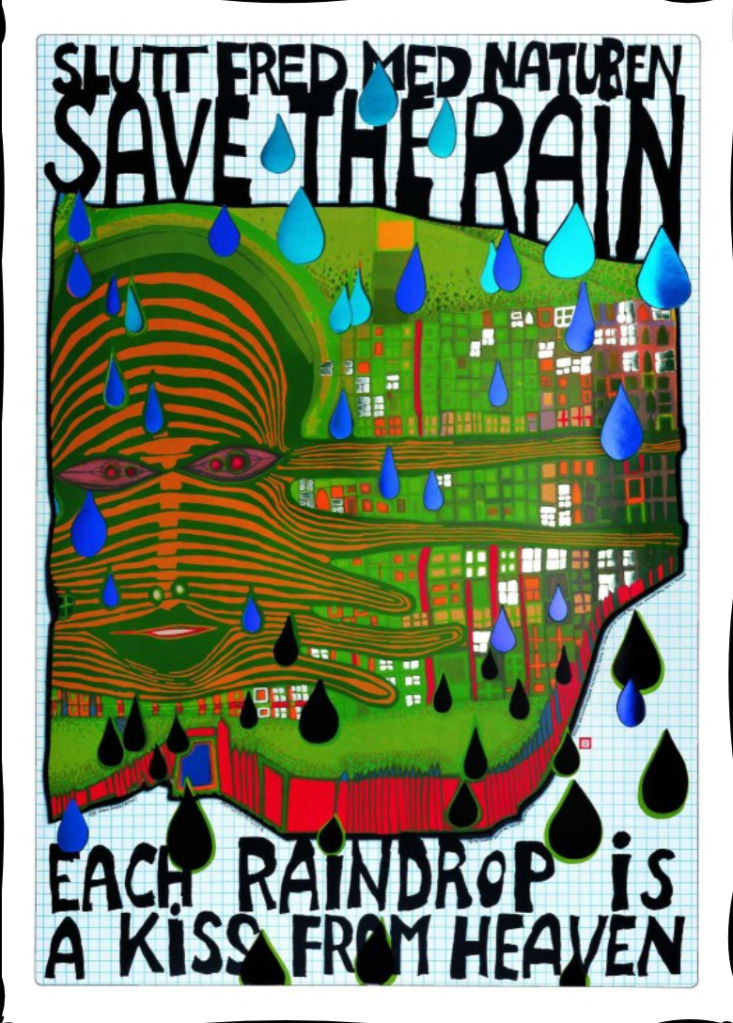
While visiting the Kunst Haus Wien, I was especially moved by Hundertwasser’s poster “Save the Rain – Each Raindrop is a Kiss From Heaven,” created for the Norwegian Nature Conservancy Association to raise awareness about acid rain and its impact on forests and fish. Seeing this work in person filled me with a deep, expansive gratitude for the miracles of the natural world.
The phrase “Each Raindrop is a Kiss from Heaven” overwhelmed me with how extraordinary our planet truly is—how every organism, from grasslands to glaciers, plays a critical role in maintaining the balance that allows us to have clean air, water, food, and medicine. These everyday miracles are sacred gifts. Protecting them is not just an act of care; it is a privilege and our responsibility as beings on this earth.
Manifestos for People and Planet
Hundertwasser spread his ecological positions in numerous manifestos, letters, and public demonstrations. His “Mouldiness Manifesto Against Rationalism in Architecture” from 1958 introduced ideas that remain profoundly relevant today, including the concept of “tree duty” which views integrating vegetation into architecture as a moral and ecological responsibility, promoting the idea that trees should grow on buildings as living architectural elements.
The 1958 manifesto generally called for humanity to restore its relationship with nature by returning to organic, evolving, and humanistic architecture. This vision foreshadowed current movements in sustainable design and biophilic architecture, which similarly emphasize harmony between humans, structures, and the environment.
Tangentially, Hundertwasser campaigned for forestation of the city through rooftop gardens and “tree tenants” that integrate greenery into urban architecture. He also developed and promoted eco-friendly waste management systems, including humus toilets and biological water purification that used aquatic plants to clean wastewater naturally.
His buildings, such as Vienna’s Hundertwasserhaus and Kunst Haus Wien, are living artworks characterized by vegetation and a jubilant embrace of imperfection.
In a world of homogenized cities and ecological neglect, his work proclaimed a rebellious return to nature.
Lessons from Hundertwasser: Honoring Non-Traditional Climate Action
Hundertwasser’s activism teaches several vital lessons. First, resistance to environmental degradation does not only require scientific credentials—it needs vision, creativity, and the courage to break away from conventional norms.
Hundertwasser’s “Everybody Must Be Creative” manifesto argues that creativity is a fundamental human right and necessity, not a privilege of artists. He condemned what he called “the new illiteracy”—the inability to create—claiming that modern civilization suppresses innate imagination through education and standardization.
Hundertwasser reminds us that solutions to complex problems such as the climate crisis demand imaginative engagement from all fields and backgrounds, making creativity an essential skill across disciplines.
His philosophy insists that ecological stewardship is a community responsibility, one that flourishes when everyone, from architects to artists and activists to ordinary citizens, claims a role in restoration and advocacy.
It is essential to recognize that climate action thrives through diversity of approach. Non-traditional methods like art, music, storytelling, and participatory design can catalyze real change, inspire empathy, and build movements.
By embracing creative resistance and fostering interdisciplinary collaboration, we can expand our impact—making space for everyone to contribute, innovate, and inspire.
To honor Hundertwasser’s legacy means advocating for the importance of art alongside science and ensuring that sustainability remains a vibrant, imaginative movement.

