Every November, roughly 46 million turkeys are killed in the United States for the sake of “American Tradition.” These are curious, socially intelligent birds capable of recognizing flock mates, forming hierarchies, and communicating with unique vocalizations, yet most are reduced to a dining table centerpiece, living just 14–20 weeks before slaughter despite a natural lifespan of 10–15 years. Their short lives, filled with fear and pain, expose the uncomfortable truth that gratitude and violence are braided together in the modern Thanksgiving ritual.
Talking about turkeys means confronting the systems—colonial, patriarchal, and capitalist—that shape their lives and deaths. Thanksgiving, too, cannot be separated from the mythologies that erase Indigenous histories, stewardship, and struggles for sovereignty. This holiday invites us to rethink what, and who, we actually celebrate, honor, and consume.
Most U.S. turkeys live in industrial sheds holding 6,000–20,000 birds and are genetically engineered to grow unnaturally heavy and fast. Their bodies become so large that many cannot stand without pain, often developing joint damage, leg deformities, and heart failure; because of these proportions, they are bred almost exclusively through forced artificial insemination, with their natural social and reproductive lives erased and relabeled as “efficiency.”
Packed tightly together, birds are subjected to “management” practices like beak trimming, desnooding, and detoeing, which remove sensitive body parts without anesthesia and can cause long-term pain, altered behavior, and difficulty eating or moving.
Most turkeys raised for Thanksgiving live on litter soaked with feces and urine under artificial lighting designed to maximize growth; their rapid weight gain often outpaces skeletal development, and many collapse from heart or lung problems. This is not tradition. It is industrial design masquerading as holiday ceremony, where bodies are treated as commodities and exploited to produce life that exists only to generate profit, encapsulating patriarchal capitalist values.
The harm of industrial turkey production does not exist in a vacuum; it is built on stolen land, exploited labor, and ecological harm —precisely the systems that ecofeminism, antispeciesism, and degrowth aim to dismantle. Barns, slaughterhouses, and feedlots sit on land taken from Indigenous peoples which are converted into monoculture grain fields, while underpaid and often migrant workers shoulder the physical risk and trauma required to keep cheap meat flowing.
Thanksgiving intensifies this logic of overproduction: ever-bigger birds, subsidized grain, and millions of pounds of turkey waste each year. In a staggering display of patriarchal capitalism’s disregard for life, it is estimated that 8 million turkeys will be thrown in the trash this Thanksgiving. In this context refusing turkey becomes more than a dietary preference; it is a small but powerful act of rejecting growth-obsessed holiday consumption in favor of justice and planetary boundaries.
And yet, as animal agriculture continues to threaten ecological stability, this year’s H5N1 bird flu outbreaks expose how fragile the turkey industry really is. Since late summer 2025, between 2 and 2.2 million turkeys have been infected or mass-killed, leaving the U.S. with its smallest turkey flock in ~40 years. Zoonotic outbreaks like H5N1 are not random accidents; they are features of a system that concentrates animals, waste, and workers in the same polluted spaces.
These mass culls—often carried out through ventilation shutdown—are presented as “biosecurity,” but they are predictable fallout of confinement, genetic uniformity, and high-density sheds, as discussed in my last post “What We Do to Nature Makes Us Sick – Literally.”
By hiding the ongoing theft and enclosure of Indigenous territories, the Thanksgiving story obscures how industrial animal agriculture depends on those same lands for feed crops, confinement facilities, and slaughter plants.
Additionally, Indigenous relationships with turkeys stretch back more than 2,000 years and offer a radically different perspective of these animals than what is normalized by Thanksgiving as its celebrated today. Historical records show that Indigenous societies in the Americas valued the birds so highly that they tamed them at least twice for companionship and participation in ceremonies.
This contrast makes clear that the way turkeys are treated today is not natural or inevitable—it is a political and economic choice.
This web of ecological and social harm reveals that struggles for land, animal liberation, and bodily autonomy are never separate. Colonial systems reshape landscapes and species to fit extractive needs, while the same logic reaches into gender and labor. What happens to the land, and what happens to the animals forced onto it, mirrors what happens to the people whose labor and autonomy are also controlled.
Ecofeminism names these shared roots and insists that none of these violences can be confronted in isolation. Instead of systems built on domination, extraction, and sacrifice zones, it asks us to move toward plant-based, low-impact, and degrowth-aligned ways of living that are grounded in care, interdependence, and respect for all beings.
Reimagining Thanksgiving through this lens means refusing to isolate animal suffering from land theft, climate chaos, and labor exploitation.
Supporting Indigenous land defenders, eating plant-based seasonal foods, and telling honest histories become interconnected acts of resistance to a system that treats life as expendable.
In place of a holiday that normalizes mistreatment, these choices move us toward traditions rooted in reciprocity, repair, and the shared right of all beings to live and thrive.
Wealth inequality and climate change are intertwined consequences of unchecked capitalist growth and the monopolization resources.
These two issues create a compounding effect: as the wealthy accumulate more wealth, their investments and purchases tend to generate more greenhouse gas emissions, which accelerates climate change and further exacerbates inequality.
Greenhouse gas emissions from both consumption and investments among the wealthiest groups have a vastly disproportionate impact on the climate crisis.
At the individual level, the ultra wealthy lead high emitting lifestyles through energy intensive consumption patterns that include things like travel, luxury goods, and ownership of large homes—often owning multiple properties which contributes to higher emissions.
For example, Jeff Bezos’ two private jets spent nearly 25 days in the air over a 12-month period and emitted as much carbon as the average US Amazon employee would in 207 years according to a 2024 OXFAM report.
Affluent groups not only consume more and purchase emissions intensive goods but their assets and investments are also funneled into emission-intensive sectors such as fossil fuels, mining, real estate and construction. Industries such as real estate and costruction are especially emissions-intensive because they rely on concrete and steel—materials with enormous quantities of embodied carbon. These investments generate considerable returns, widening the wealth gap, while also producing massive carbon footprints.
A 2025 study analyzing emissions inequality from1990-2020 found that two-thirds of warming can be attributed to the wealthiest 10%, with average emissions 6.5 times higher than the average per capita rate. To further put this disparity into perspective, a 2024 OXFAM report found that the world’s fifty richest billionaires produce more carbon through their investments, private jets, and yachts in just 90 minutes than the average person emits in an entire lifetime.
How Does Capitalism Influence Wealth Inequality?
A foundational critique of capitalism is its ability to concentrate economic gains among owners while workers receive only a fraction of the value they create. This surplus extraction has intensified with globalization and automation, leading to stagnant wages and declining worker power— trends widely documented by economists at the Economic Policy Institute and the OECD.
Under this model, wealth breeds more wealth: those with capital can invest and earn higher returns than those relying on wages, compounding inequality over time. This self-reinforcing dynamic is now supported by econometric evidence showing that every increase in wealth concentration significantly exacerbates carbon inequality—meaning the environmental footprint of the richest grows much faster than the average individual.
Research from the World Inequality Lab reveals that public policies often serve to perpetuate these divides, especially when they favor interest of wealth holders through tax breaks, deregulation, and subsidies that disproportionately benefit capital owners.
At its foundation, capitalism prioritizes endless economic growth while disregarding planetary boundaries. Corporate interests drive extraction, pollution, and emissions as structural features of the system.
Why Capitalism and Climate Justice Can’t Coexist
Capitalism perpetuates climate change by embedding exploitation of people, land, and resources into its design. The wealth gaps created by this system ensure those least responsible for the climate crisis bear the greatest impacts, both nationally and globally.
Within the United States, capitalist production has created stark patterns of environmental injustice. Many of the most polluted areas are home to low-income communities who face the externalized costs of corporate profit. In Bakersfield, CA —one of three California metro areas with the largest increases in concentrated poverty from 2010-2018 —is surrounded by oil fields, intensive agriculture, and industrial zones. Weak enforcement of pollution controls enables business owners to cut costs and increase profits, while residents experience higher rates of asthma, contaminated water, and degraded air quality.
On a global scale, capitalism’s colonial and imperial roots continue to shape climate injustice. Wealthy nations such as the United States and members of the European Union account for the majority of historical greenhouse gas emissions, shaping climate impacts felt by countries who have significantly lower GHG footprints and GDP’s. The wealth that fueled industrialization in the Global North was extracted through centuries of resource theft, forced labor, and ecological destruction in colonized regions.
This legacy persists today through global trade structures, debt systems, and extractive industries that keep poorer nations dependent and vulnerable. Countries with the smallest carbon footprints now face the greatest exposure to extreme heat, sea-level rise, and food insecurity—while former colonial powers maintain economic dominance built on ecological harm and human exploitation.
Calls for climate reparations and responsibility recognize the disproportionate contribution of wealthy, historically colonial nations to the climate crisis. Addressing the climate crisis requires not only reducing emissions but confronting the capitalist structures that have normalized extraction, inequality, and ecological violence in pursuit of endless growth.
Solutions: Anti-Capitalist Degrowth Models
The interconnected crises of inequality and climate change cannot be solved within the same economic system that created them. Incremental reforms through green growth models or corporate sustainability pledges merely tinker at the margins of a structure built on exploitation. As thinkers like Kohei Saito and Jason Hickel argue, confronting climate breakdown requires a radical reorientation of our economies away from endless accumulation and toward collective well-being.
Degrowth provides a vision for reorganizing society around equity, and care. Under degrowth frameworks, economic success is measured not by GDP, but by metrics such as community health, ecological restoration, access to essential services, and time for leisure and creativity. The goal is to downscale unnecessary production—particularly luxury consumption and resource-intensive industries—while ensuring that everyone’s fundamental needs are met within planetary boundaries.
Ownership and control are central. If the wealthiest individuals and corporations dominate the financing of renewable energy and climate adaptation, their share of global wealth will continue to grow, deepening inequality even in a decarbonized world. Conversely, public, cooperative, and community-owned models demonstrate how climate action can redistribute both power and resources.
Degrowth also challenges the colonial logic of extraction that still shapes global trade. It calls for ecological reparations, debt cancellation, and the end of exploitative resource flows from the Global South to the Global North. In practice, this means investing in ecosystem restoration, housing cooperatives, and localized supply chains rather than fossil-fuel expansion and militarized borders.
The climate crisis is not an unintended consequence of capitalism—it is the inevitable outcome. Addressing it means redistributing wealth and transforming how we define prosperity, progress, and justice. Dismantling capitalist growth imperatives is not merely an economic task, but a moral and ecological one: a necessary step toward a livable planet for all.
Art has long served as a catalyst for change, connecting information to emotion and inspiring action. In the face of the climate crisis, human imagination may play a critical role in environmental activism by bridging creativity and science to drive transformation and innovation.
Several studies and projects support the idea that art can be a powerful driver for climate awareness.
For example, research published in ScienceDirect demonstrates that artistic activism fosters emotional engagement, behavioral change, and civic participation. Additionally, the US Global Change Research Program has found that climate art exhibitions and educational programs can encourage communities to see themselves as part of the solution, inspiring both dialogue and action.
Collaboration between arts and sciences transforms information into a sensory experience, which makes it more likely that the information will elicit emotion and remain in our memory.
Art’s power lies in its ability to make us feel before we act. By tapping into emotion, it connects intellectual awareness to moral responsibility. Art brings humanity to urgent political and environmental issues, allowing audiences to encounter them with new perspectives. This turns observation into involvement, inspiring people to envision how we might live differently in the future.
As one artist-scholar observed, “The universal language of art can encourage people from all different backgrounds to want to develop actions to help live more sustainably.”
Art, in this sense, becomes an act of resilience. It reminds us that that restoring our bond with the environment can be as creative as it is urgent.
Encountering Hundertwasser: A Philosophy of Color, Form, and Nature
My personal belief in the power of art as climate action was reinforced during a trip to Vienna several years ago. I had saved my pennies for several years and planned the trip around viewing works from my two of my favorite painters, Gustav Klimt and Egon Schiele, leaders of the Viennese Secession Movement whose paintings shaped my understanding of creative freedom. But it was while I was in Vienna that I encountered a new figure who would expand my thinking even further: Friedensreich Hundertwasser.
My first encounter with his work was at the Kunst Haus Wien, where I was enthralled by the unusual curved lines and bright hues covering the face of the building. While visiting this magnificently strange structure and viewing the paintings inside, I learned that Hundertwasser was not only an artist and architect, but an ecological visionary and environmental activist as well.
His work merged creativity and activism into one beautifully radical philosophy. Deeply inspired by the Viennese Secession Movement, which sought to break away from artistic nationalism and the conservative art establishment of the Austrian Empire, Hundertwasser envisioned an art form that healed both people and the planet.
His work rejected modernist straight lines, which he referred to as “godless and immoral,” in favor of spirals, organic patterns, and radiant colors that celebrated life’s natural irregularity. He was a leader in the development of new techniques and the use of unconventional materials often using homemade paints made from organic materials while having mastered many graphic techniques including lithograph, silk screen, etching, woodcut and mixed media.
Hundertwasser believed that humanity had created a separation from nature that was detrimental to both people and the planet and that this “aberration” must be reversed. His artworks often depict structural, environmental, and human elements while advocating for harmony between them.
Hundertwasser summarized his idea of a life in harmony with the laws of nature in seven points which are outlined in his “Peace Treaty With Nature.”
Ecological Conservation Through Art
Hundertwasser created original posters in support of environmental protection efforts such as whale conservation and the promotion of public transport. He dedicated the revenue from these posters to various environmental organizations, which was a key component of his environmental protection strategy.
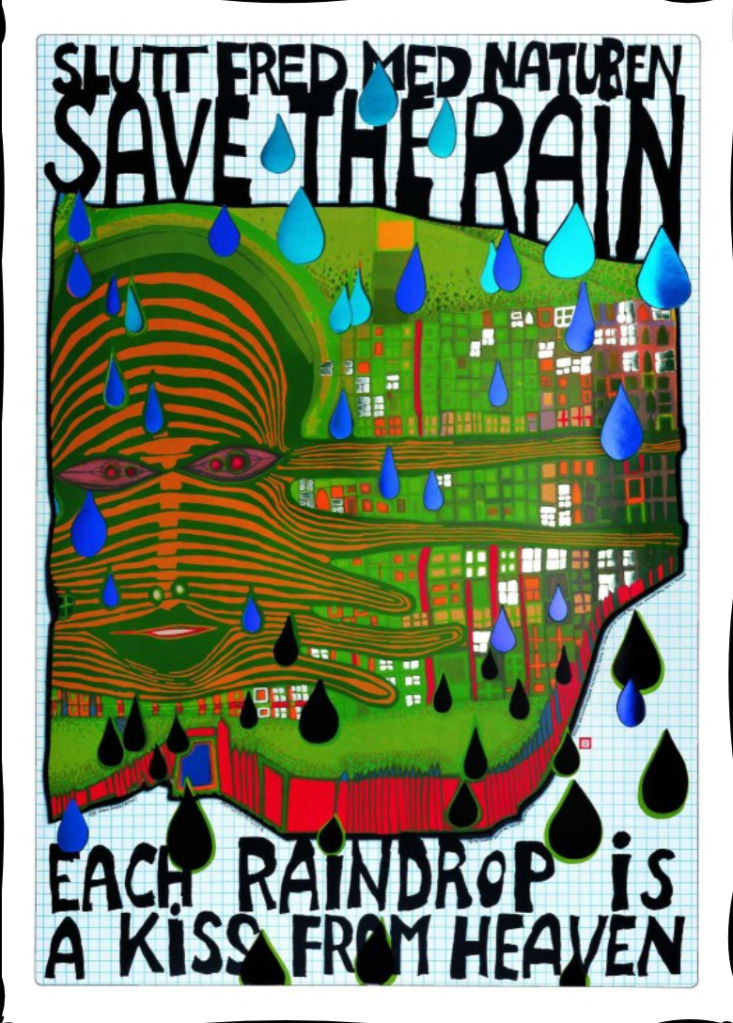
While visiting the Kunst Haus Wien, I was especially moved by Hundertwasser’s poster“Save the Rain – Each Raindrop is a Kiss From Heaven,” created for the Norwegian Nature Conservancy Association to raise awareness about acid rain and its impact on forests and fish. Seeing this work in person filled me with a deep, expansive gratitude for the miracles of the natural world.
The phrase “Each Raindrop is a Kiss from Heaven” overwhelmed me with how extraordinary our planet truly is—how every organism, from grasslands to glaciers, plays a critical role in maintaining the balance that allows us to have clean air, water, food, and medicine. These everyday miracles are sacred gifts. Protecting them is not just an act of care; it is a privilege and our responsibility as beings on this earth.
Manifestos for People and Planet
Hundertwasser spread his ecological positions in numerous manifestos, letters, and public demonstrations. His “Mouldiness Manifesto Against Rationalism in Architecture” from 1958 introduced ideas that remain profoundly relevant today, including the concept of “tree duty” which views integrating vegetation into architecture as a moral and ecological responsibility, promoting the idea that trees should grow on buildings as living architectural elements.
The 1958 manifesto generally called for humanity to restore its relationship with nature by returning to organic, evolving, and humanistic architecture. This vision foreshadowed current movements in sustainable design and biophilic architecture, which similarly emphasize harmony between humans, structures, and the environment.
Tangentially, Hundertwasser campaigned for forestation of the city through rooftop gardens and “tree tenants” that integrate greenery into urban architecture. He also developed and promoted eco-friendly waste management systems, including humus toilets and biological water purification that used aquatic plants to clean wastewater naturally.
His buildings, such as Vienna’s Hundertwasserhaus and Kunst Haus Wien, are living artworks characterized by vegetation and a jubilant embrace of imperfection.
In a world of homogenized cities and ecological neglect, his work proclaimed a rebellious return to nature.
Lessons from Hundertwasser: Honoring Non-Traditional Climate Action
Hundertwasser’s activism teaches several vital lessons. First, resistance to environmental degradation does not only require scientific credentials—it needs vision, creativity, and the courage to break away from conventional norms.
Hundertwasser’s “Everybody Must Be Creative” manifesto argues that creativity is a fundamental human right and necessity, not a privilege of artists. He condemned what he called “the new illiteracy”—the inability to create—claiming that modern civilization suppresses innate imagination through education and standardization.
Hundertwasser reminds us that solutions to complex problems such as the climate crisis demand imaginative engagement from all fields and backgrounds, making creativity an essential skill across disciplines.
His philosophy insists that ecological stewardship is a community responsibility, one that flourishes when everyone, from architects to artists and activists to ordinary citizens, claims a role in restoration and advocacy.
It is essential to recognize that climate action thrives through diversity of approach. Non-traditional methods like art, music, storytelling, and participatory design can catalyze real change, inspire empathy, and build movements.
By embracing creative resistance and fostering interdisciplinary collaboration, we can expand our impact—making space for everyone to contribute, innovate, and inspire.
To honor Hundertwasser’s legacy means advocating for the importance of art alongside science and ensuring that sustainability remains a vibrant, imaginative movement.
Transition Towns are grassroots community projects that aim to increase self-sufficiency and build local resilience to global challenges such as climate change, peak oil, and socioeconomic instability.
The movement began at Kinsale Further Education College in Ireland, where permaculture teacher Rob Hopkins and his students developed an Energy Descent Action Plan to respond to peak oil. Hopkins later moved to Totnes, England, in 2006, where he helped found the first Transition Town– a community-led initiative to foster local resilience through projects focused on energy, food, and economy.
Since then, the Transition Network has expanded internationally to over 60 countries. Unique among environmental movements, Transition Towns emphasize not only practical solutions but also psychological and social change, nurturing skill development, connection, and collective action.
Skill Development and Behavioral Change: Building Lasting Climate Resilience
Central to the Transition movement is the facilitation of skill development as a key climate solution and resilience tool.
This process addresses the fact that many practical skills crucial for sustainability—such as food growing, clothing repair, and resource efficiency– have been lost over time as convenience culture has taken precedence over longevity.
Transition initiatives create hands-on workshops, courses, and community projects that revive these essential skills, enabling people not only to become more self-sufficient but also to share and pass these skills through families and neighbors.
For instance, in Totnes, the original Transition Town, a popular 10-week evening course called “Skilling Up for Powerdown” teaches participants about food, energy, water, and economics, all through the lens of enhancing local resilience.
An incredibly useful training for starting a Transition Initiative is Transition Launch, which teaches people how to set up and run a community-based change-making initiative right where they live.
Practical Workshops and Community Learning
There are also numerous smaller practical workshops, such as herbal walks, natural building, cooking, and cycle maintenance. These workshops are designed to be engaging and inclusive, drawing on the expertise of local elders, experts and practitioners to bridge knowledge gaps.
Through herbal walks, participants not only gain knowledge of local plants and wildlife but also strengthen their bonds with both their community and natural environment.
Natural building workshops teach participants how to construct buildings using sustainable, natural, and locally sourced materials like earth, straw, timber, and stone. These workshops emphasize eco-friendly techniques to build environmentally conscious structures that are energy-efficient, and healthy for people and the planet.
Meanwhile, cycle maintenance courses not only provide instruction on how to perform essential bicycle repairs and upkeep, but also help cyclists gain confidence and practical skills to be a safe cyclist on the road.
Skill-sharing fosters behavioral change by transforming abstract concerns about climate and energy into practical, achievable actions. Learning by doing builds a fundamental sense of “can do” and empowerment, replacing feelings of helplessness with tangible capabilities. These shared learning experiences help build adaptable, supportive networks essential for collective problem-solving and long-term sustainability.
By nurturing both individual skills and community connections, Transition Towns not only reduce ecological footprints but also strengthen the social fabric necessary to sustain environmental efforts over time. Furthermore, as skills are passed on within communities, they create a multiplying effect—giving the Transition Town movement a legacy of resilience that extends beyond any one person, project or generation.
Expanding Skill-Sharing Across the Network
Transition hubs across the transition network have run repair cafés, gardening courses, energy-saving workshops, local currency initiatives, and numerous practical projects that bring learning and action together. These efforts contribute to a culture shift where sustainability becomes normalized, encouraging ongoing participation and deeper engagement.
Repair Cafés: Repair Cafés allow community members to bring broken household items (clothes, small appliances, bikes) for free repair by skilled volunteers. The goal is to reduce waste, save money, and share repair skills. This promotes a culture of fixing rather than discarding, reducing landfill waste and fostering community sharing. Combined with the transition network’s focus on skill sharing, the number of skilled volunteers grows over time so no community member is overly relied upon to perform repairs. Transition Pasadena has run Repair Cafés in California since 2013, involving city staff and volunteers, and offering extensive repair activities for electronics, clothing, and household items.
Gardening Courses: Community gardening and food-growing courses equip participants with skills in organic cultivation, composting, seed saving, and sustainable garden design. In Transition Town Lewes, regular gardening workshops and community orchards help restore local food sovereignty while strengthening neighborhood ties through shared green spaces.
Crystal Palace Transition Town’s Community Garden offers another inspiring example. What began as a small local food-growing project has evolved into a thriving hub for gardening and food-related initiatives. Today, it regularly hosts events and workshops on composting, foraging, and permaculture, providing a space where residents can both learn and connect.
Energy Savings Workshops: Transition groups across the network have implemented hands-on energy projects that reduce emissions while empowering households and communities to take action. For example, Totnes, UK facilitated a street-by-street program where neighbors met in small groups to learn about energy, water, food, and transport. In its first year, around 550 households cut an average of 1.3 tonnes of CO₂ per year each (saving ~£570 per household).
Community Energy Cooperatives: Transition members in Lewes, UK helped establish OVESCO, a community energy co-op. Together they’ve installed around 6 MW of local solar power, and offer free energy-advice workshops and drop-in sessions on bills, home efficiency, and renewables.
Global Diffusion and Local Adaptation
From its UK origins, the Transition Towns model has spread to over 60 countries worldwide, including diverse contexts in Europe, North America, Australia, Latin America, and Asia. Each community adapts the core principles to its unique social, cultural, and environmental setting.
For example, in the US Southwest, initiatives in places like Joshua Tree, California focus on desert-appropriate permaculture and water conservation, while community efforts in Toulouse, France established “micro-forests” through the Miyawaki method to rapidly create dense, biodiverse urban ecosystems. The creation of these micro-forests expands on the city’s already established connection to Japanese landscaping as Toulouse is home to the remarkable Jardin japaonais Pierre-Baudis.
This flexibility allows the movement to thrive globally, making sustainability locally relevant while demonstrating how local priorities, cultures, and resources shape diverse transition projects worldwide.
Inner Transition: Emotional Processing for Collective Resilience
Transition Towns highlight that sustainable change requires transforming not only infrastructure and behavior but also values, emotions, and relationships.
“Inner Transition” is a concept and movement, often associated with the global Transition Network, that focuses on the psychological, emotional, spiritual, and relational changes necessary for people and communities to shift from unsustainable ways of living to more resilient, connected, and meaningful ones.
It emphasizes personal and collective well-being and aims to integrate inner work with external practical projects, ensuring the “head, heart, and hands” are aligned to foster sustainable change.
By integrating practices from psychology and social change with community action, they offer a holistic model of resilience. This approach unleashes collective genius, turning fear and uncertainty into hope and empowerment—a powerful narrative as communities worldwide adapt to global environmental challenges.
Confronting emotions directly helps participants build personal resilience, preventing burnout and sustaining long-term engagement. In this way, hope and imagination are cultivated as practical tools, inspiring members to envision and work toward a positive, sustainable future.
This emotional work transforms despair into “applied optimism,” motivating collective action.
How Transition Towns Foster Hope and Agency
Transition Towns empower citizens by fostering a sense of ownership over their community’s future and encouraging proactive, pragmatic solutions.
Participants develop new skills, launch local enterprises, and collaborate with community members to integrate resilience into local planning.
The movement encourages “doing stuff” and learning by experimentation, making resilience a learned skill.
The transition network offers online courses and events which can be found here with 2 upcoming webinars in October 2025.
Additionally, you can view where there may be transition groups, trainers and hubs near you with this map on the transition network website.
Cecilia was an embodiment of compassion, her quiet gaze falling on what others overlooked: the elm tree in the yard, the “othered” boy at a party, species facing extinction. In her presence, small details grew unbearably heavy, as if she carried the grief of the world before she had even lived much of it.
To be a compassionate person living through the sixth mass extinction and the rise of fascism is to feel that same weight—a witness to a civilization numbed by capitalism and distraction, yet burdened with knowledge.
Cecilia’s attention to suffering is not merely sensitivity: it is radical witness. She refuses to let the decline of the natural world or the pain of the vulnerable fade into the background hum of everyday life.
Watching The Virgin Suicides now, what lingers is not its pastel suburban nostalgia but the undercurrent of warning woven into every frame. The film feels like a mirror, revealing the mundane ways our own world ignores cries for help until monumental tragedy erupts.
“The Brazilian turbot frog was added to the endangered species list today. That’s the third animal this year.”
As scientific consensus declares our world is in the midst of its sixth mass extinction, society insists we carry on as though nothing has changed. Capitalism numbs us with relentless demands, leaving little room for mourning. Extinction becomes something to scroll past, something someone else will fix. It hums behind commutes and the tired sigh at the end of a shift. The weight of it is carried silently by those who still feel it, those whose compassion refuses to shut down.
In The Virgin Suicides, this dynamic is captured in miniature. Cecilia speaks with clarity, her words sharpened by her reserved demeanor, but her mother is distracted—hands busy performing unpaid domestic labor, mind splintered across endless obligations. It is not cruelty that keeps her from actively engaging, but exhaustion, the kind that dulls empathy. The Lisbon household becomes a metaphor for our society at large: a place where care exists but isn’t given the attention it deserves, where voices of warning are muffled by the ceaseless clatter of survival, societal expectations, and maintaining the status quo.
Unlike the five mass extinctions that came before—driven by meteors or volcanic eruptions—this one is driven by humans. Greenhouse gases emitted in the process of manufacturing unnecessary goods raise global temperatures, land-use change devours habitats to grow crops for animals that were bred purely for the sale of their dead bodies, and synthetic chemicals permeate ecosystems. Species are vanishing at 1,000 to 10,000 times the natural rate with nearly 40% of amphibians and a third of all assessed species now standing on the brink of existence.
To feel this devastation while living under the very system that creates it is infuriating. Capitalism steals our time and mental energy even as it drives pollution and ecological collapse. Simultaneously, our political and economic systems block climate solutions because they are not immediately profitable. Life on Earth is sacrificed for quarterly earnings reports.
During the Trump administration, this unraveling only accelerated. The EPA pursued the largest deregulatory campaign in U.S. history, rolling back more than thirty protections on clean air, water, and climate. Efforts were made to revoke the endangerment finding—the scientific foundation for regulating greenhouse gases—effectively stripping federal authority to regulate greenhouse gas emissions. The Department of Energy expanded oil and gas leasing and expedited approvals for liquefied natural gas. By allowing for increased, unregulated emissions as scientists warn of irreversible tipping points, the administration made its position clear: profit will be protected, even if it means sacrificing life itself.
Meanwhile, the National Environmental Policy Act was hollowed out, cutting public input and oversight, giving corporations unprecedented access to public lands with minimal accountability. The Endangered Species Act was revised so that only direct killing of a species counted as “harm,” allowing habitat destruction from mining, logging, and development even in areas where species are facing extinction.
The result: expanded drilling and logging in once-protected areas, collapsing protection of land and wildlife, and increasing threats to species from the lynx to the cutthroat trout.
This is the disease that will kill the planet, the relentless prioritization of corporations and profit over living beings. Entire species were written off as collateral damage for short-term profit. It is the same logic that underpins patriarchy and fascism: that life—human or nonhuman—can be measured, exploited, and discarded when inconvenient.
Under U.S. law, corporations are granted personhood, giving businesses more rights than entire species of animals that are capable of feeling grief and pain as their food supply and habitats are destroyed.
Just as entire species are erased for profit, so too are people devalued when their existence doesn’t serve the dominant order.
“Everyone, look! His ears wiggle if you scratch his chin!”
At Cecilia’s party, a boy with Down syndrome named Joe becomes the target of thoughtless amusement. The guests chant for Joe to “sing [his] song,” laugh as they scratch under his chin to make his ears wiggle, and reduce him to a spectacle. Cecilia’s expression grows doleful before she quietly excuses herself to her room, for the last time.
The cruelty at this party echoes forward into our own time, where governments stage wars against those who deviate from the dominant mold. Fascist systems rely on this dehumanization—reducing entire populations to caricatures or burdens—to justify harm.
I do not blame the boys mocking Joe; they are children shaped by a society that rewards cruelty and punishes difference. In this world, vulnerability is branded as weakness, and to stand out is to invite ridicule. Cecilia, by contrast, represents those who refuse to fall under the spell of apathy—the ones who can recognize injustice without needing it explained and feel it too heavily to ever partake in being part of the status quo that upholds it.
The Trump administration echoed this mockery with severe, targeted campaigns against marginalized groups, including disabled people. It slashed workplace protections, undermined housing rights, cut critical disability services like Medicaid, and weakened equity in education—each policy signaling that disabled people were obstacles to profit rather than humans deserving dignity.
Executive orders called for forced institutionalization of people with mental health disabilities and the unhoused, while funding was cut from community-based, evidence-backed programs. Simultaneously, decades of diversity, equity, and inclusion efforts were unraveled, rolling back protections for women, people of color, LGBTQ+ communities, and minority-owned businesses.
Dehumanization, once embedded in law, normalizes violence against the most marginalized. This has been a cornerstone of U.S. policy since the founding of our nation, enabling systemic oppression of marginalized groups for centuries.
To stand with Cecilia is to know the ache of compassion. To witness systemic cruelty with an open heart is to carry grief, to refuse numbness, and to choose solidarity over convenience, even when it hurts. It binds us to one another, insisting that we recognize injustice rather than look away.
“Elm trees. How many pages can you write about dying trees?”
As the boys sift through Cecilia’s journal, they dismiss her many entries on the elm trees in their neighborhood as boring. Yet her attention to the ordinary is a radical act.
Throughout the film, the dying elm trees stand as a symbol of decline—a slow disease spreading through the neighborhood, mirroring the suffocation inside the Lisbon home. The neighborhood’s impulse to cut them down reflects the desire to sanitize decay, to maintain a façade of suburban stability by erasing what feels uncomfortable.
Cecilia’s devotion to protecting the elms is her refusal to turn away from truth and suffering. She embodies what it means to remain present with loss in a culture that prefers distraction, denial, forgetting, and toxic positivity. To mourn openly, to name tragedy, to refuse normalization is itself resistance.
In our own time, being able to grieve climate and humanitarian crises is resistance: it breaks through the capitalist logic that tells us to keep working, keep consuming, keep scrolling. The girls’ ability to be present with the dying trees mirrors those who understand the magnitude of loss our planet is currently experiencing, yet continue trying to heal it.
Climate optimism divorced from grief is blind ignorance. To pretend that the reversal of climate protections and the acceleration of planetary damage under Trump’s policies are anything less than devastating is dishonest. But grief need not paralyze us.
When we allow ourselves to feel the weight of what has been lost, we clear the ground for informed action—organizing, advocating, voting, defending the vulnerable, and demanding policies that restore life and dignity.
“Given Lux’s failure to make curfew, everyone expected a crackdown. But few expected it would be so drastic.”
When Lux breaks curfew on the night of the homecoming dance, all the sisters are punished. Their brief taste of freedom collapses into total isolation. Lux is forced to destroy her rock records—ritualistically cutting off rebellion and self-expression.
This scene reflects a broader political truth: freedoms granted to women under patriarchy are always conditional. When women step too far outside the lines, those freedoms are swiftly revoked.
The Lisbon sisters’ confinement reflects the powerful backlash against feminist gains over recent decades. Throughout the 2010s, feminist activism surged globally: #MeToo exposed pervasive sexual harassment, more women entered parliaments and leadership positions, and advances in reproductive rights, education, and workplace protections expanded possibilities for women worldwide. Intersectional approaches linked gender justice to racial, economic, and environmental struggles, increasing visibility and solidarity.
However, the early 2020s witnessed a wrenching rollback. The Trump administration catalyzed a rapid erosion of women’s rights: abortion access was severely restricted in multiple states, federal funding for women’s health and family planning was slashed by billions, and research on women’s health was defunded. These efforts often weaponized “gender ideology” rhetoric to justify aggressive anti-rights campaigns, fueling a broader resurgence of fascist and ultraconservative forces globally.
The persistence of this backlash reveals a grim truth: women’s freedoms remain fragile, granted only on patriarchal terms. The Lisbon sisters’ punishment after their brief glimpse of freedom is a stark metaphor for our moment—reminding us that the struggle for bodily autonomy, justice, and liberation from patriarchal control is far from over.
“If the boats didn’t bring the fungus from Europe, none of this would have happened.”
As the landscapers prepare to tear down Cecilia’s beloved elm, the sisters cry out in protest. Bonnie reminds us that Dutch elm disease was not some inevitable act of nature but a byproduct of human trade and carelessness—fungus carried across oceans on ships, entwined with commerce. The landscapers’ solution, cutting the tree at its base, is cruelly ironic: it attacks the symptom while leaving the deeper systems of circulation and extraction that enabled the disease in the first place untouched.
Likewise, mainstream visions of “green growth” treat ecological collapse as a technical glitch to be patched with electric cars and renewable technologies—solutions often accessible only to the privileged—while ignoring the extractive capitalist, colonial, and industrial systems that drive ongoing environmental devastation.
The logic of infinite growth, heralded as progress, clashes fundamentally with the reality of a finite Earth. Humanity currently consumes natural resources at a rate equivalent to 1.7 Earths annually, outpacing the planet’s ability to regenerate.
Efficiency gains boasted about by green growth advocates often provoke more consumption rather than less, and “decoupling” growth from extraction remains illusory at the scale our survival demands. Overreliance on technological solutions and market-driven approaches risks perpetuating exploitation and inequality rather than remedying them.
True repair requires a reimagining of how we live with the land and with one another. A holistic response sees ecological, social, technological and economic systems as bound together, demanding solutions that honor planetary limits while centering justice and care. It means dismantling the conditions that created the climate crisis, and building systems rooted in reciprocity, not profit.
“Our daughter showed us an article. It’s a less aggressive therapy.”
While the sisters continue to protect Cecilia’s elm tree, their father recalls her suggestion of a less aggressive therapy than cutting them down and offers it to the landscapers.
The treatment Cecilia proposed echoes the values of ecofeminism. Ecofeminism critiques patriarchal systems that dominate and exploit both women and the natural world, offering instead an ethic of holistic care, reciprocity, and regeneration. It emphasizes that nurturing and healing are not sentimental choices but ethical necessities.
Cecilia’s quiet advocacy for regeneration over destruction mirrors this ethos. She resists the reflex toward violence and control, choosing repair and restoration instead.
Yet the suggestion is brushed aside, dismissed as impractical. The landscaper embodies the worldview of patriarchal capitalism: one that trusts only in domination and quick fixes, unable or unwilling to acknowledge the need for deeper transformation. From this vantage, technological solutions are enough, while the roots of exploitation—patriarchy, capitalism, colonialism—remain invisible, untouched.
This denial exposes the obstacle at the heart of our ecological crisis. The same system that isolates the girls and destroys the elms is the one that devours the earth’s resources and rescinds women’s rights when our presence threatens its control.
Without confronting the systems that train us to treat life as disposable, attempts at “repair” will replicate the same harm. True healing demands more: a commitment to regenerative ways of living grounded in justice, care, and respect—the very principles ecofeminism offers, and the wisdom the Lisbon sisters carried in their refusal to turn destruction into inevitability.
“It didn’t matter in the end how old they had been, or that they were girls, but only that we had loved them… and that they hadn’t heard us calling, still do not hear us calling them out of those rooms where they went to be alone for all time.”
After the sisters’ deaths, the neighborhood boys turn them into myth, stitching together fragments and half-memories.
This is how collapse is so often met: we romanticize what is gone rather than fight for what remains. We write elegies for species we failed to save. Memory becomes a poor substitute for justice.
The Lisbon girls did not need elegy; they needed to be heard. The same is true of our burning forests, our poisoned rivers, our sisters who are having their rights revoked and our neighbors who are treated as disposable by systems of profit and control.
The tragedy of The Virgin Suicides is not only the girls’ deaths but the silence that surrounded them—the refusal to recognize despair until it was too late. The greater tragedy would be to repeat that mistake now—to ignore grief, to dismiss the calls for change—until it is too late.
In our highly modernized urban landscapes, the 21st-century man often yearns for the wild adventures of imperial explorers from centuries ago. On weekends, they flee the drudgery of their 9-to-5 routines, seeking solace in nature’s grandeur—long-distance running through fields, climbing to the highest peaks, and gliding down snow-capped slopes. These landscapes promise beauty and joy, and an escape from the monotonous reality of daily life.
Yet, beneath this pursuit of beauty and excitement lies a troubling pattern. The earth becomes a playground for exploitation, a backdrop for thrill and profit, with its habitats rarely cared for and the boundaries of the planet ignored and disrespected. Too often, the well-being of nature is neglected, just as the well-being of women is disregarded and undervalued.
This is not a relationship of reverence, but one of conquest—where nature is engaged with only through doing, proving, and performing. In this worldview, stillness is weakness, and appreciation without extraction is unthinkable.
The male voyager who dreams of visiting the earth’s most scenic destinations simultaneously ignores the degraded ecosystems that lie in between. He prefers that the deforested habitats with eroded soil, reduced fertility, and inability to support plant life any longer remain out of view— like a woman who no longer serves his fantasy. Whether it’s the body of a woman or the body of the Earth, what is not useful to him is ignored.
As men set off on expeditions to indulge in personal growth and discovery by exploring their “motherland,” we women are left to wonder why we have no fatherland. If a woman yearned for the same experience, she would first have to reckon with the threat of violence—from the very men who claim the right to roam without fear.
Under patriarchy, many men relate to women the same way they relate to nature: they desire only select fragments of the experience, never the whole. Their gaze lingers on isolated parts of the female body, stripped of emotion, thought, or need. Likewise, their relationship with nature fixates on curated landscapes that offer escape and pleasure—spaces that ask nothing in return. In both cases, the full being is ignored, left uncared for, while he takes what he wants and offers no restoration or consideration in return.
Just as patriarchal systems fragment and objectify women, the dominant scientific paradigm dissects nature into categories and data points, stripping it of spirit, wholeness, and complexity. Male-dominated science systems, especially under colonial and capitalist influence, have long sought to classify, control, and extract rather than to listen, witness, and honor. The desire to “know” nature is often driven not by reverence, but by a need to dominate—just as women are judged and placed into boxes instead of being embraced in the full spectrum of our experience. In both cases, mystery is feared, and complexity is flattened to serve power.
While it’s important to recognize how Western science has historically been shaped by colonial and patriarchal systems, it’s equally vital to honor the truth in many of its findings—especially when they reveal the urgent need for ecological care.
Scientists warn that ecosystems may begin collapsing as soon as the 2030s under high-warming scenarios. Yet nearly half of conservative men deny the validity of climate science and the integrity of these projections. Just as the needs of nature are overlooked and seen as exaggerated under patriarchal systems—the stories and rights of women are often dismissed as false and treated with the same disregard.
I have been confidently reminded by countless men in my life that nature has a way of healing itself as justification for their lack of concern about environmental remediation or protection. But nature can only heal itself from the current level of degradation if there are actions to support the healing process. This may include afforestation and reforestation projects that improve soil health, water cycle regulation, and carbon sequestration.
This logic, used to excuse inaction, mirrors how society treats women: assuming we will keep nurturing, healing, and caretaking, even as we’re denied support ourselves. Women provide free labor in domestic settings with little support in place to sustain these efforts. The conditioned emotional unavailability of men masked as masculinity leaves women carrying not just the burdens of the home, but the parts of ourselves that men refuse to hold.
Just as women’s caregiving labor is invisible yet foundational, nature performs essential labor that goes largely unrecognized. Ecosystem services like filtering air, cycling water, regulating the climate, and enabling food production are treated as infinite and free, even though they are the very systems that make human life possible. These life-sustaining processes, much like the domestic and emotional work women perform, are rarely accurately valued, protected, or even acknowledged.
This pattern of denial and devaluation is no accident— it’s embedded in a larger system that places profit above preservation, and domination above care. Patriarchal capitalism has grossly undervalued nature for much of its existence. Global natural capital has been estimated to be worth $125 trillion yet, nature markets today are valued at only $9.8 trillion.
As millions of acres of virgin land are opened to oil drilling, creating a product that will only further degrade the land, man’s inability to see intrinsic value without exploitation mirrors how he treats the women in his life. The global economy is built upon a logic that profits from domination and renders care invisible, with billion dollar industries built on the exploitation of the natural world and the exploitation of women—making it fundamentally reliant on undervaluing both.
Like nature, our beauty is appreciated by man, providing experiences of pleasure and joy. We become the memories that make life worth living. But, we are rarely truly listened to, cared for, or recognized for our full value. We are lusted after, never loved— celebrated for what we offer, but not honored for who we are.
As a woman, I cherish my beauty. I know its light and magnetism. It has given me connection, expression, and even power. But beauty should not be a reason for exploitation, nor a barrier to being cared for. I want to be held in my wholeness—my strength, my abilities, my sorrow and joy, my stillness and storm. I deserve to be cared for, not conquered.
Like a goodhearted, patient woman who puts up with the constant chaos of a fiery man, nature is expected to do the same. To tolerate constant growth and expansion that feeds the desire for economic gain and domination harbored by men in patriarchal capitalist systems.
Our societal structures support relationships devoid of genuine care and connection, enabling further disregard for human and ecological needs on a larger scale. This dysfunction reveals the urgent need for systemic change that confronts the intertwined roots of gender-based oppression and environmental degradation.
Despite how patriarchal systems have long exploited women’s caring and healing capacities—without recognition or support—these traits remain powerful forces for transformation.
Compassion, empathy, and emotional depth—qualities often labelled as “feminine”—must be revalued and woven into the foundations of any system that seeks sustainability, justice, and collective healing. These traits are not weaknesses to be exploited, but strengths that offer a path forward—when shared, respected, and integrated across societal structures.
Throughout history, women have played a critical role in preserving the earth’s health—not just metaphorically, but through direct action. Women in rural and indigenous communities often possess deep knowledge of local ecosystems and have led protective efforts to sustain them.
For example, in 1973, in the forests of the Indian Himalayas, a group of rural women led by Gaura Devi launched the Chipko Movement, which involved physically hugging trees to prevent them from being demolished. Their act of resistance was not only a defense of the forest, but of their community’s water, soil, and food systems. This was an embodied form of care—one that shows how women’s ecological knowledge and care translates into radical protection.
This movement, like many others led by women across the globe, reminds us that care is not passive—it is defensive, assertive, and necessary for survival. In contrast to the extractive logic of patriarchal capitalism, these actions reassert a model of relationship based on interdependence and protection, rather than conquest.
As women under patriarchal capitalism, we must be unwavering in our knowing of our own self worth. We are the creators of life—yet we must still fight to have our contributions recognized, our rights respected, and our full humanity honored. Just as we rise to defend our own dignity, we must rise to defend the ecosystems that sustain all life on Earth.
Many climate scientists, environmental activists, and researchers, including myself, now reject green growth models, not because of an opposition to progress or innovation, but because the promises of “green growth” in already high-income countries are fundamentally incompatible with the scale of ecological and social challenges present across the globe.
This preference toward degrowth is rooted in mounting scientific evidence, supported by a recent groundbreaking review published in Lancet Planetary Health titled “Post-growth: the science of wellbeing within planetary boundaries,” which challenges the assumption that economic growth is necessary or even desirable for societal progress.
A central argument made by the authors is that the dominant narrative, which claims technological innovation and efficiency will allow for continued economic growth while reducing environmental harm, is not supported by the data. Efficiency improvements are consistently outpaced by the scale and speed of economic expansion, leading to increased resource consumption, pollution, and waste—a phenomenon known as the “rebound effect.” This effect directly undermines the idea that growth can be decoupled from environmental harm.
The belief that technological solutions alone can address today’s ecological crises exposes the use of binary thinking to address a multifaceted problem. This technological optimism can distract from the deeper, systemic changes needed to address how societies produce, consume, and define prosperity. Overreliance on technological solutions risks obscuring the fundamental drivers of climate change and social inequality. While technological shifts and innovation will play a role, it cannot substitute for the deeper structural changes needed to address how societies produce, consume, and define prosperity.
Research shows that market-driven approaches and the current economic system delay effective climate action by hindering the deployment of transformative technologies. Many promising climate innovations struggle to secure funding or scale because profit-driven systems tend to prioritize short-term returns over long-term societal and environmental benefits. Ironically, green growth models also rely on rapid technological deployment as a climate solution, while many proposed solutions are either unproven at scale or insufficient to address the magnitude of the problems.
Moreover, renewable energy and other sustainable technologies are not without environmental and social costs. The extraction of minerals essential for batteries and electronics, such as cobalt and lithium, is frequently linked to environmental degradation and human rights violations. This is not to suggest that clean energy should be dismissed, but rather that its deployment must be accompanied by systemic reforms. Without broader economic and policy changes, such technologies risk perpetuating existing patterns of overconsumption, social inequalities and human rights violations.
Crucially, the pursuit of endless economic growth is fundamentally incompatible with the Earth’s ecological boundaries. Humanity has already exceeded six of nine planetary boundaries, threatening the stability of Earth’s life-support systems. The drive for economic expansion, especially in high-income countries, is largely responsible for this overshoot, often achieved at the expense of labor and resources in lower-income nations. High-income countries, in particular, have a disproportionate impact on global emissions and resource use, and their current levels of consumption are unsustainable. If these consumption patterns persist, they are likely to precipitate ecosystem collapse and irreversible climate impacts across the globe. To avert ecological catastrophe and biodiversity loss, high-income countries must significantly reduce their material and energy use.
Green growth strategies tend to prioritize harm reduction through technological innovation and decarbonization, while neglecting the restorative practices needed to regenerate ecosystems.Even when labeled as “green,” economic growth models frequently fail to deliver meaningful social or ecological outcomes due to the fact that market-driven interventions often neglect ecosystem restoration that is viewed as “non-profitable”. A shift in priorities is needed—from GDP growth to enhancing human well-being, equity, and ecological regeneration.
True sustainability requires a deliberate reduction in material throughput, regeneration of depleted ecosystems, and advancement of social equity. It is not enough to simply shift to “greener” forms of production and consumption if they still enable the exploitation and oppression of nature and non-dominant groups.
As highlighted in recent research published in The Lancet Planetary Health, degrowth offers a scientifically grounded pathway to remain within planetary boundaries while improving health and well-being (Beyer et al., 2024). By intentionally reducing overall consumption and production—particularly in high-income countries—and reorienting economies toward equity, social cohesion, and ecological restoration, we can address the root causes of environmental degradation and social inequality.
The Lancet article emphasizes that degrowth is not about austerity or deprivation, but about prioritizing human flourishing, reducing unnecessary work and consumption, and ensuring that everyone’s basic needs are met. This approach has the potential to lower pollution, reduce greenhouse gas emissions, and restore ecosystems, while also improving life satisfaction, reducing stress, and strengthening community ties.
These findings point the way toward a healthier planet, fairer societies, and a higher quality of life for all—achieved not through endless economic expansion, but through a fundamental transformation of our values, priorities, and systems. It’s time to embrace a new vision of progress—one rooted in ecological balance, equity, and genuine well-being.
As of 2025, the World Economic Forum ranks misinformation and disinformation as the most urgent short-term global threats. While over the next decade, environmental risks dominate, with extreme weather, biodiversity loss, ecosystem collapse, critical shifts in Earth systems, and resource shortages leading the list of long-term risks.
With disinformation regarding the cost of extreme weather events increasing under the Trump Administration, paired with egregious efforts to reverse the expansion of clean energy and climate action, unaddressed climate risks pose systemic threats to financial stability.
Physical risks: Physical risks can be characterized as acute or chronic, and stem from the direct effects of climate change. Acute physical risks can range from floods, wildfires and storms while chronic physical risks include rising temperatures, sea level rise, and precipitation patterns that can impact crop yields and water scarcity. These events can destroy infrastructure, disrupt supply chains, and lead to large-scale asset losses.
Transition risks: There are four kinds of transition risks: regulatory, technological, market, and reputational. These arise from the economic, technological and regulatory adjustments required to align with global emissions targets and the shift to a low-carbon economy. Policy changes, technological disruption, and changes in market preferences can lead to stranded assets, sudden changes in asset valuations, and increased legal liabilities for firms exposed to fossil fuels.
The financial effects of climate risks can be forecasted in various warming scenarios as well as policy and socioeconomic scenarios using scenario analysis. It is best practice to use Representative Concentration Pathways (RCPs) and Shared Socioeconomic Pathways (SSPs) as defined by the Intergovernmental Panel on Climate Change (IPCC) to explore climate impacts in various plausible futures.
In high warming scenarios, physicals risks present the highest financial risks due to the fact that increased warming will lead to a higher number of costly natural disasters that disrupt supply chains and damage infrastructure. Whereas, in low warming scenarios, transition risks are higher as there will be a more rapid and distinct shift towards renewable energy and more sustainable practices.
Physical risks differ from transition risks because of tipping points—critical thresholds in natural systems that, once crossed, can trigger irreversible change. While the timing of such tipping points is debated, scientists warn of potentially catastrophic impacts if emissions remain unchecked, with some predicting a point of no return by 2035.
Both risk types can destabilize the financial system via several channels:
Credit risk: Rising defaults as firms and households struggle with climate damages or the declining value of fossil fuel assets.
Liquidity risk: Market freezes as uncertainty spikes and asset values become volatile. For example, after hurricanes or floods, households and businesses rapidly withdraw deposits to fund recovery, straining banks’ liquidity buffers.
Underwriting risk: Insurance losses mount as more regions become uninsurable, undermining the business model of insurers and their ability to absorb shocks.
Market risk: Rapid repricing of assets and increased volatility as investors reassess climate exposures.
Systemic climate risks are magnified by the interconnectedness of banks, insurers, and investment funds. Losses in one sector can quickly transmit through the financial system, triggering broader instability. For example, insurers retreating from high-risk regions can spark credit crunches, reduce lending, and depress property values, while banks exposed to fossil fuel assets may face sudden losses and liquidity strains.
These financial risks do not operate in isolation. Instead, they are amplified by political decisions, institutional structures, and the retreat of state-sponsored data collection and oversight.
Amplification Through Financial and Political Networks
With the recent announcement that The National Oceanic and Atmospheric Administration (NOAA) has ceased tracking the financial impact of weather events linked to climate change, including floods, wildfires, heat waves and hurricanes, it will become increasingly more difficult to assess current and future costs related to extreme weather events. This change is a result of decisions made by the Trump Administration, supporting their efforts to remove references to climate change from federal documents and resources.
Financial risks are traditionally incorporated into the financial system as a core element which influences investment decisions, market pricing and the general allocation of capital.
Currently, climate related risks are in the early developments of being appropriately tracked, measured, and managed within the global financial system as an increasing number of financial regulators recognize that climate change poses significant economic and financial risks.
For example, the European Union requiring companies to assess, report on, and track management of climate-related risks and their financial effects over a phased in timeline as part of the Corporate Sustainability Reporting Directive (CSRD).
As climate-related risk measurement, reporting and management is an emerging field itself with financial institutions highlighting that investors are underappreciating and underpricing climate-related risks, this decrease in reliable data is likely to exacerbate the underpricing of climate risks, leading to sudden, disruptive repricing in the future that could threaten financial stability.
Capitalism’s Structural Conflict with Climate Action as Evidenced by Transition Risks
Capitalism’s core feature of prioritizing short-term profit maximization directly conflicts with the long-term planning required for climate stability.
This creates what economists call “emergent contradictions,” where short-term economic gains lead to long-term environmental costs. The fossil fuel industry exemplifies this contradiction-remaining economically profitable while significantly driving carbon emissions that threaten planetary stability.
In a stark display of capitalism’s self-destructive nature, transition risks have fueled organized opposition to climate policy through political channels. For example, industry lobby groups have repeatedly succeeded in blocking regulations or carbon taxes, significantly delaying necessary climate action. This represents not just individual companies protecting their interests but a systemic feature of capitalism where concentrated economic interests can mobilize against policies that serve broader social needs.
Regulatory transition risks often stem from the introduction of carbon pricing or emissions regulations, which can lead to “a large decline in the value of fossil capital” and the phenomenon of “stranded assets.” These stranded assets reveal one of the clearest ways in which capitalism structurally resists climate action: rather than embracing transformation, industries have powerful financial incentives to delay, weaken, or derail climate policy in order to protect existing investments.
Although Environmental, Social, and Governance (ESG) frameworks, corporate sustainability, and stakeholder capitalism have emerged to align business with sustainability, their voluntary nature and inconsistent implementation have largely failed to produce systemic change.
This failure is particularly evident in the U.S., where the political landscape increasingly favors climate denial, fossil fuel expansion, and deregulation. In this context, many corporations are pulling back from ESG reporting, citing reputational risks, regulatory uncertainty, and rising costs, which highlights the limitations of voluntary compliance in a disinformation-driven, privatization-heavy system.
ESG reporting requires both effort and resources, compounded by the challenge of sourcing reliable climate data, these challenges are only intensifying in a political environment hostile to transparency and science.
In the corporate sustainability space, investments in climate action typically require a compelling business case that demonstrates either cost savings or a positive return on investment (ROI). These business cases must be socialized and approved internally, often facing resistance due to competing financial priorities.
However, a core problem remains: financial modeling in capitalist firms typically uses timeframes far shorter than those used in climate models. This misalignment leads companies to prioritize short-term profitability, often opting for inaction—even when the long-term risks of inaction are catastrophic.
The reality is this: the long-term cost of inaction far exceeds the upfront investment in mitigation or adaptation. Without decisive climate action:
The natural resources essential for production will become too scarce or degraded to use.
Transportation and distribution networks will be damaged or destroyed by extreme weather.
Consumer markets will collapse as people are displaced—or, in some cases, cease to exist.
Policy Uncertainty and Investment Retraction
With a patriarchal capitalist leading the country, in the first quarter of 2025 alone, nearly $8 billion in clean energy projects were canceled, closed, or downsized, as manufacturers and investors responded to the rollback of tax credits and regulatory support. This marks a dramatic reversal from the surge in clean energy investment following the Inflation Reduction Act, and signals a broader hesitation to commit capital amid uncertain policy signals.
Economic Consequences:
Stalled clean energy growth: The cancellation of large-scale projects in wind, solar, and battery manufacturing has slowed industry expansion and job creation.
Increased exposure to fossil fuel risks: Delayed transition raises the risk that banks and insurers will be left holding stranded fossil fuel assets, amplifying credit and market risks.
Reduced resilience to physical climate impacts: Without robust investment in mitigation and adaptation, uninsured losses from extreme weather events are expected to rise, straining public finances and deepening economic inequality.
Systemic instability: Allianz and other major insurers warn that, as climate risks become uninsurable, the financial system faces the prospect of cascading failures in housing, credit, and investment markets-potentially threatening the foundations of capitalism itself.
The Self-Defeating Nature of Capitalism
Ironically, capitalism’s resistance to climate action threatens the system itself. As financial experts warn, continued failure to address climate change means “no more mortgages, no new real estate development, no long-term investment, no financial stability. The financial sector as we know it ceases to function. And with it, capitalism as we know it ceases to be viable.”
This demonstrates how transition risks represent not just evidence of capitalism’s resistance to climate action but also its potential self-destruction through that very resistance.
The intersection of environmental collapse, financial instability, and political resistance reveals a system on the brink. Without structural reform, both ecological and economic breakdowns are not only likely—they are mutually reinforcing.
Since the 1990s, evidence supporting animal sentience has increased tenfold, demonstrating that animals possess the capacity for subjective experiences like pleasure and pain—states previously believed beyond their reach. This surge in evidence has amplified the animal rights movement, spotlighting the injustices prevalent in animal agriculture, research, testing, and challenging normalized societal views of animals.
Photo by Caroline S.
A pivotal moment in this revolution was the establishment of Animal Sentience in 2015. This academic journal became the first to exclusively study the capacity of nonhuman animals to feel and think. By integrating ethics, neuroscience, animal behavior, and welfare science, Animal Sentience has provided a centralized, peer-reviewed platform for interdisciplinary research, marking formal recognition of animal sentience as a legitimate scientific field.
This milestone followed the Cambridge Declaration on Consciousness (2012), which affirmed that many nonhuman animals possess neurological substrates for consciousness.
By legitimizing research on subjective experiences in animals, Animal Sentience challenged behaviorist paradigms that had dominated much of the 20th century.
The journal’s influence extends to policy, with its research supporting legal protections for species like cephalopods and decapods in the EU and UK. The incorporation of animal sentience into UK law through the Animal Welfare (Sentience) Act 2022 demonstrates growing societal acknowledgment of animals’ capacity for suffering, supporting calls to end practices like factory farming and animal testing.
While these legal protections have helped improve animal welfare and awareness of animal rights, there is still much work to be done to implement the findings of the animal sentience revolution into industry and society.
Moreover, Animal Sentience has strengthened ethical arguments against practices like factory farming and animal research by highlighting evidence of sentience across diverse taxa.
In essence, Animal Sentience has played a critical role in advancing scientific understanding, fostered interdisciplinary collaboration, influenced policy changes, and shifted societal attitudes toward recognizing animals as sentient beings deserving moral consideration.
The New York Declaration challenges paradigms in ethics, neuroscience, and societal norms. It explicitly rejects the assumption that consciousness requires human-like brain structures and the idea of human exceptionalism in understanding animal consciousness.
As the Declaration states, “The architecture for consciousness in other animals may look completely different than in humans… It is irresponsible to ignore [this] in decisions affecting animals.”
By challenging anthropocentric biases and recognizing consciousness as a trait shared across diverse species with varying neural architectures, the New York Declaration provides a framework for integrating scientific findings into ethical decision-making, urging society to reevaluate its treatment of animals in agriculture, research, and other industries.
The declaration marks a pivotal moment in the science of animal minds by combining empirical evidence with moral responsibility, pushing for systemic changes in how humans interact with nonhuman animals.
It also emphasizes that absolute certainty about consciousness is not required to take ethical precautions, advocating instead for a precautionary principle in decision-making.
If there is even a realistic possibility that an animal can suffer or experience harm, policymakers should consider this when crafting laws and regulations. By assuming consciousness, we can create better animal welfare practices and ensure that no sentient beings are harmed.
If consciousness isn’t human-specific, speciesist hierarchies (e.g., prioritizing mammals over fish) become untenable. This realization highlights the fact that speciesism is a construct, and thus our understanding of speciesism is shaped by human perception and cultural systems, rather than being an objective, universally fixed reality.
Building on this foundation, the ASENT Project (2019-2024) has challenged binary classifications of sentience by proposing a multidimensional framework that considers valence (pleasure/pain), arousal (intensity), self-awareness, and social awareness across species.
By rejecting binary thinking, ASENT helps us understand that sentience isn’t one-size-fits-all. It’s not just about whether an animal can feel pain – it’s also about how deeply they experience the world around them. Are they self-aware? Can they form social bonds? And what’s the emotional intensity behind their experiences?
ASENT’s spectrum model widens our definition of sentience, allowing for what is classically considered partial evidence (e.g., chickens showing empathy) to warrant ethical safeguards.
The ASENT framework emphasizes taking preventative action when there is a threat of harm by stating that “Uncertainty about sentience does not justify inaction.”
These milestones highlight a critical point: sentience should not be a prerequisite for welfare.
Because our understanding of sentience is largely based on the human experience, there is a high likelihood that animal consciousness differs from our own in ways we may not fully comprehend, which is further complicated by humans’ incomplete understanding of our own species’ consciousness.
Animals that have not been proven sentient are labeled as non-sentient until proven otherwise, leading to the risk of inflicting harm on sentient beings.
As science evolves, more species are recognized as sentient, underscoring the need to assume sentience until proven otherwise and to grant welfare to all species based on their intrinsic value. The intrinsic value of animals refers to the idea that animals have inherent worth, independent of their usefulness or value to humans, meaning their lives are valuable in and of themselves.
Additionally, breakthroughs in neuroscience and ethology show that animals previously thought incapable of feeling pain—such as crustaceans and cephalopods—are indeed sentient. This evidence dismantles arguments justifying their use in food and research industries and further supports the argument to assume consciousness until proven otherwise.
The utilitarian classifications of living organisms used in the speciesist hierarchy lays the foundation for humans to justify inflicting harm on each other based on perceived traits of moral or performance superiority.
Speciesism places Homo sapiens at the top of a hierarchy that is used to justify sacrificing other animals. Harmful practices and ideas about animals that are deprioritized in the speciesist hierarchy are used to rationalize colonial practices and violence towards groups of people.
Speciesism allows certain animals to be exploited and treated as commodities to accommodate human needs and desires, while other animals with the same capacity to experience emotion can be considered family.
In 1999, the Treaty of Amsterdam went into force, granting animals official recognition as sentient beings in the EU, which demonstrates widespread acceptance of animal sentience. However, the practices used in animal agriculture and animal testing disregard the fact that animals such as cows, pigs, chickens, and rats are capable of experiencing a significant range of emotions, including fear, stress, pain, social bonds, joy, empathy and affection. This juxtaposition highlights a significant level of cognitive dissonance associated with the production and consumption of animal products as well as products tested on animals.
Despite our knowledge of their ability to experience subjective states, chickens, pigs, and cows are viewed as commodities in society, raised simply for consumption without deliberation on their wellbeing.
In industrialized agriculture, these animals are confined in cramped, unsanitary conditions to maximize production, leading to suffering and disease. Calves are separated from their mothers within a few hours of birth and male piglets are castrated without anesthesia. However, the normalization of speciesism in society enables people to turn a blind eye to the 10 billion animals that are killed on factory farms in the USA annually and their suffering.
Humans must challenge our idea of superiority in the animal kingdom, recognizing that we are animals too. It is unjust to engage with practices such as laboratory testing, animal agriculture, and the destruction of natural habitats due to the distress and pain these practices inflict on innocent, sentient beings in addition to the harm they inflict on the Earth.
Vegan ethics align with the scientific consensus on animal consciousness and the urgency of staying within planetary boundaries.
The convergence of animal sentience science, climate urgency, and planetary boundary breaches creates a compelling ethical and ecological case for transitioning to veganism in the U.S. Here’s how these elements interconnect:
“Humane Slaughter” is an oxymoron, as the Humane Slaughter Act excludes 9.7 billion chickens and turkeys slaughtered annually, allowing live-shackling and ineffective stunning. Even for covered species, 16% of cows are ineffectively stunned during slaughter due to rushed bolt-gun procedures resulting in repetitive stunning or slaughter while conscious. Additionally, there are countless allegations of abuse, violations, and deceptive practices against farms that hold humane farming certifications. For example, investigations into Plainville Farms, a Global Animal Partnership certified facility, revealed workers kicking, beating, and throwing turkeys, with sick and injured birds left untreated. Animal Welfare Certified Farms have been found guilty of animal abuse, including workers kicking birds and forcing screaming pigs into gas chambers.
The New York Declaration urges avoiding harm where consciousness is a “realistic possibility.” Given ASENT’s evidence, this includes all vertebrates and most invertebrates used in agriculture. The precautionary principle dictates that uncertainty about sentience does not justify inaction. Veganism offers a solution, reducing suffering by eliminating demand for animal products, which directly reduces slaughter rates, and mitigates climate change by shifting to plant-based diets, potentially cutting agricultural emissions by 49% and land use by 76%.
Rejecting speciesism is not only a moral choice but also crucial for the planet’s survival.
Developments in animal sentience science confirm that animals experience subjective states such as pain, fear, empathy, and pleasure, making their exploitation morally indefensible.
Sentience-based ethics challenge speciesism by dismantling the hierarchy that places human interests above those of non-human animals.
Evidence of animal cognition, such as playful behaviors in bees and problem-solving in octopuses, underscores the ability of science to evolve overtime and the need to assume consciousness in order to ensure that no sentient beings are harmed.
These scientific advancements strengthen the moral argument for veganism by revealing the inherent suffering and exploitation in animal agriculture, advocating for systemic change in research, societal norms, and practices. Moreover, they challenge anthropocentrism by showing that consciousness is not uniquely human nor reliant on familiar neural structures. We must recognize that sentience is a spectrum with diverse evolutionary origins, and revise animal welfare laws, research ethics, food systems, and our relationship with nonhuman life.
As we witness both the decline of women’s rights and the weakening of environmental protections, the ecofeminist movement has become more crucial than ever.
Shane Rounce, Unsplash.com
Ecofeminism is a philosophical and political movement that emerged in the 1970s, connecting feminist and environmental concerns by recognizing the interconnected oppression of women and nature under patriarchal systems. The term was coined by French feminist Françoise d’Eaubonne in 1974, sparking a wave of academic and activist interest. Throughout the 1970s and 1980s, ecofeminism gained traction as scholars and activists explored the links between gender inequality and environmental degradation.
Key figures in the movement include Vandana Shiva and Maria Mies, whose work has been instrumental in shaping ecofeminist theory and practice. Together, Shiva and Mies developed a comprehensive ecofeminist framework that emphasizes the interconnectedness of social and ecological issues, challenges the dominant paradigm of exploitation, and promotes a more sustainable and equitable world.
Patriarchal capitalism simultaneously exploits women and nature through interconnected systems of domination that view both women and nature as resources to be controlled and exploited for profit. As evidenced by Shiva and Mies, our capitalist-patriarchal framework has led to environmental degradation, the marginalization of women, and the erosion of sustainable economies.
Shiva argues that women, especially in the Global South, often bear the brunt of this exploitation as they are the primary caretakers of natural resources and communities while being most vulnerable to climate impacts. Patriarchal capitalism not only perpetuates gender inequality but also threatens the very foundations of life by undermining ecological balance and sustainable practices. This system is built on a hierarchical worldview that prioritizes masculine traits like dominance and aggression while devaluing feminine qualities such as compassion and empathy.
Traditionally feminine traits such as compassion and empathy are critical to include in the formation of systems that prioritize sustainability, longevity and equality over endless economic growth powered by exploitation. Research demonstrates a strong correlation between women’s political leadership and proactive climate change policies. Countries with higher percentages of women in parliament consistently show greater commitment to environmental protection, evidenced by their increased likelihood to ratify international climate treaties and implement more stringent environmental regulations. There is a statistically significant and positive correlation between the presence of women in climate negotiations and an increased mention of gender in climate policy discussions. This suggests that women’s participation leads to increased climate action in general as well as more comprehensive and effective climate responses by amplifying the focus on gendered impacts within environmental policy.
Furthermore, there is a profound connection between women and biodiversity as women play a critical role in preserving the earth’s health. Women in rural and indigenous communities often possess deep knowledge of local ecosystems and sustainable resource management practices. This traditional ecological knowledge is invaluable for developing effective conservation strategies and sustainable land use practices.
Shiva states that “the marginalization of women and the destruction of biodiversity go hand in hand,” highlighting women’s position as both vulnerable to and crucial for conserving biodiversity.
Ecofeminist alternatives seek to promote systems that support a sustainable world which radically reimagines our economic and social structures, recognizes the importance of all living things, and prioritizes regeneration and equality over exploitation and domination. This movement is more urgent than ever in the current state of climate emergency paired with increasing violence against women and diminishing women’s rights.
The Trump Administration has amplified interrelated social and environmental challenges as the they have withdrawn the US from the Paris agreement, removed climate change mentions from USDA websites, reversed support and incentives for low-carbon technology, overturned women’s rights resulting in increased maternal mortality and significant threats to women’s health, while setting the precedent that violence against women is acceptable.
President Trump and many of his elected officials have been accused and convicted of sexual assault and abuse, perpetuating and further normalizing exploitation of women’s bodies. Upholding this kind of behavior supports a culture that takes women’s ownership of their bodies away from them and puts it in the hands of those who want to harm and control them. This sends the message that your body does not belong to you and you don’t get to control what happens to it which is exactly what anti-reproductive rights movements support.
Similarly, patriarchal capitalists have normalized and rewarded practices that abuse the earth by polluting ecosystems, degrading soil quality, and exploiting natural resources in pursuit of personal and economic gain with no regard for the impact this has on ecosystems and the beings that live within them.
In this context, ecofeminist principles have become more critical than ever, offering a framework for understanding and addressing the intertwined issues of environmental protection and women’s rights. By recognizing the intersection of social inequalities and climate change, we can develop more effective and equitable solutions that address the unjust systems which have supported the current level of environmental degradation and inequality.
Elevating women’s voices in environmental policymaking and ensuring their active participation in climate action is crucial for creating comprehensive and impactful strategies to combat the climate crisis.
Ecofeminist solutions often promote alternative economic models such as subsistence economies, recognizing their potential to reduce environmental impact and foster community resilience. A subsistence economy is one where economic activity is primarily directed towards needs rather than profit. This shifts economic focus onto necessities without overexploiting resources, thus these economies naturally tend to stay within planetary boundaries and sustainable ecological limits. By emphasizing local production and consumption, ecofeminism advocates for decentralized models that can lead to shorter lead times, lower transportation costs, and increased flexibility in meeting local demands.
Prioritizing ecofeminist values and strategies can inspire collective climate action by reframing narratives, addressing root causes, empowering diverse voices, fostering community-based solutions, promoting holistic approaches, and cultivating hope and resilience.