Tag: climate-change

  • An Invitation to Rethink Thanksgiving

    Every November, roughly 46 million turkeys are killed in the United States for the sake of “American Tradition.” These are curious, socially intelligent birds capable of recognizing flock mates, forming hierarchies, and communicating with unique vocalizations, yet most are reduced to a dining table centerpiece, living just 14–20 weeks before slaughter despite a natural lifespan of 10–15 years. Their short lives, filled with fear and pain, expose the uncomfortable truth that gratitude and violence are braided together in the modern Thanksgiving ritual.

    Talking about turkeys means confronting the systems—colonial, patriarchal, and capitalist—that shape their lives and deaths. Thanksgiving, too, cannot be separated from the mythologies that erase Indigenous histories, stewardship, and struggles for sovereignty. This holiday invites us to rethink what, and who, we actually celebrate, honor, and consume.

    Photo by Meelika Marzzarella on Unsplash

    Most U.S. turkeys live in industrial sheds holding 6,000–20,000 birds and are genetically engineered to grow unnaturally heavy and fast. Their bodies become so large that many cannot stand without pain, often developing joint damage, leg deformities, and heart failure; because of these proportions, they are bred almost exclusively through forced artificial insemination, with their natural social and reproductive lives erased and relabeled as “efficiency.”

    Packed tightly together, birds are subjected to “management” practices like beak trimming, desnooding, and detoeing, which remove sensitive body parts without anesthesia and can cause long-term pain, altered behavior, and difficulty eating or moving.

    Most turkeys raised for Thanksgiving live on litter soaked with feces and urine under artificial lighting designed to maximize growth; their rapid weight gain often outpaces skeletal development, and many collapse from heart or lung problems. This is not tradition. It is industrial design masquerading as holiday ceremony, where bodies are treated as commodities and exploited to produce life that exists only to generate profit, encapsulating patriarchal capitalist values.

    The harm of industrial turkey production does not exist in a vacuum; it is built on stolen land, exploited labor, and ecological harm —precisely the systems that ecofeminism, antispeciesism, and degrowth aim to dismantle. Barns, slaughterhouses, and feedlots sit on land taken from Indigenous peoples which are converted into monoculture grain fields, while underpaid and often migrant workers shoulder the physical risk and trauma required to keep cheap meat flowing.

    EPA analysis of animal feeding operations documents how these facilities generate concentrated manure, air pollution, and water contamination, turning nearby communities and ecosystems into sacrifice zones. Turkey manure is a significant source of pollution, and animal agriculture overall drives at least 14.5% of global greenhouse gas emissions while occupying about 80% of U.S. agricultural land when accounting for all livestock and their feed crops.

    Thanksgiving intensifies this logic of overproduction: ever-bigger birds, subsidized grain, and millions of pounds of turkey waste each year. In a staggering display of patriarchal capitalism’s disregard for life, it is estimated that 8 million turkeys will be thrown in the trash this Thanksgiving. In this context refusing turkey becomes more than a dietary preference; it is a small but powerful act of rejecting growth-obsessed holiday consumption in favor of justice and planetary boundaries.

    And yet, as animal agriculture continues to threaten ecological stability, this year’s H5N1 bird flu outbreaks expose how fragile the turkey industry really is. Since late summer 2025, between 2 and 2.2 million turkeys have been infected or mass-killed, leaving the U.S. with its smallest turkey flock in ~40 years. Zoonotic outbreaks like H5N1 are not random accidents; they are features of a system that concentrates animals, waste, and workers in the same polluted spaces.

    These mass culls—often carried out through ventilation shutdown—are presented as “biosecurity,” but they are predictable fallout of confinement, genetic uniformity, and high-density sheds, as discussed in my last post “What We Do to Nature Makes Us Sick – Literally.”

    While entire barns of turkeys are being killed by diseases produced under colonial agricultural conditions, the Thanksgiving myth of Pilgrims and peaceful feasts continues to sanitize the very systems that inflicted parallel harms on Indigenous peoples. It frames settlers as generous hosts while erasing the Wampanoag and other Indigenous peoples’ harvest ceremonies, land relations, and histories of epidemic and dispossession.

    By hiding the ongoing theft and enclosure of Indigenous territories, the Thanksgiving story obscures how industrial animal agriculture depends on those same lands for feed crops, confinement facilities, and slaughter plants.

    Additionally, Indigenous relationships with turkeys stretch back more than 2,000 years and offer a radically different perspective of these animals than what is normalized by Thanksgiving as its celebrated today. Historical records show that Indigenous societies in the Americas valued the birds so highly that they tamed them at least twice for companionship and participation in ceremonies.

    This contrast makes clear that the way turkeys are treated today is not natural or inevitable—it is a political and economic choice.

    This web of ecological and social harm reveals that struggles for land, animal liberation, and bodily autonomy are never separate. Colonial systems reshape landscapes and species to fit extractive needs, while the same logic reaches into gender and labor. What happens to the land, and what happens to the animals forced onto it, mirrors what happens to the people whose labor and autonomy are also controlled.

    Under this lens, the Thanksgiving rituals that rely on women’s unpaid domestic labor and men’s authority at the carving knife become easier to recognize as extensions of patriarchal and colonial power.

    Ecofeminism names these shared roots and insists that none of these violences can be confronted in isolation. Instead of systems built on domination, extraction, and sacrifice zones, it asks us to move toward plant-based, low-impact, and degrowth-aligned ways of living that are grounded in care, interdependence, and respect for all beings.

    Reimagining Thanksgiving through this lens means refusing to isolate animal suffering from land theft, climate chaos, and labor exploitation.

    Supporting Indigenous land defenders, eating plant-based seasonal foods, and telling honest histories become interconnected acts of resistance to a system that treats life as expendable.

    In place of a holiday that normalizes mistreatment, these choices move us toward traditions rooted in reciprocity, repair, and the shared right of all beings to live and thrive.

  • How Is Wealth Distribution Related to Climate Change?

    Wealth inequality and climate change are intertwined consequences of unchecked capitalist growth and the monopolization resources.

    These two issues create a compounding effect: as the wealthy accumulate more wealth, their investments and purchases tend to generate more greenhouse gas emissions, which accelerates climate change and further exacerbates inequality.

    Photo by Elyse Chia on Unsplash

    Disproportionate Emissions

    Greenhouse gas emissions from both consumption and investments among the wealthiest groups have a vastly disproportionate impact on the climate crisis.

    At the individual level, the ultra wealthy lead high emitting lifestyles through energy intensive consumption patterns that include things like travel, luxury goods, and ownership of large homes—often owning multiple properties which contributes to higher emissions.

    For example, Jeff Bezos’ two private jets spent nearly 25 days in the air over a 12-month period and emitted as much carbon as the average US Amazon employee would in 207 years according to a 2024 OXFAM report.

    Affluent groups not only consume more and purchase emissions intensive goods but their assets and investments are also funneled into emission-intensive sectors such as fossil fuels, mining, real estate and construction. Industries such as real estate and costruction are especially emissions-intensive because they rely on concrete and steel—materials with enormous quantities of embodied carbon. These investments generate considerable returns, widening the wealth gap, while also producing massive carbon footprints. 

    A 2025 study analyzing emissions inequality from1990-2020 found that two-thirds of warming can be attributed to the wealthiest 10%, with average emissions 6.5 times higher than the average per capita rate. To further put this disparity into perspective, a 2024 OXFAM report found that the world’s fifty richest billionaires produce more carbon through their investments, private jets, and yachts in just 90 minutes than the average person emits in an entire lifetime.

    How Does Capitalism Influence Wealth Inequality?

    A foundational critique of capitalism is its ability to concentrate economic gains among owners while workers receive only a fraction of the value they create. This surplus extraction has intensified with globalization and automation, leading to stagnant wages and declining worker power— trends widely documented by economists at the Economic Policy Institute and the OECD.


    Under this model, wealth breeds more wealth: those with capital can invest and earn higher returns than those relying on wages, compounding inequality over time. This self-reinforcing dynamic is now supported by econometric evidence showing that every increase in wealth concentration significantly exacerbates carbon inequality—meaning the environmental footprint of the richest grows much faster than the average individual.


    Research from the World Inequality Lab reveals that public policies often serve to perpetuate these divides, especially when they favor interest of wealth holders through tax breaks, deregulation, and subsidies that disproportionately benefit capital owners.​

    At its foundation, capitalism prioritizes endless economic growth while disregarding planetary boundaries. Corporate interests drive extraction, pollution, and emissions as structural features of the system.​

    Why Capitalism and Climate Justice Can’t Coexist

    Capitalism perpetuates climate change by embedding exploitation of people, land, and resources into its design. The wealth gaps created by this system ensure those least responsible for the climate crisis bear the greatest impacts, both nationally and globally.

    Within the United States, capitalist production has created stark patterns of environmental injustice. Many of the most polluted areas are home to low-income communities who face the externalized costs of corporate profit. In Bakersfield, CA —one of three California metro areas with the largest increases in concentrated poverty from 2010-2018 —is surrounded by oil fields, intensive agriculture, and industrial zones. Weak enforcement of pollution controls enables business owners to cut costs and increase profits, while residents experience higher rates of asthma, contaminated water, and degraded air quality.

    On a global scale, capitalism’s colonial and imperial roots continue to shape climate injustice. Wealthy nations such as the United States and members of the European Union account for the majority of historical greenhouse gas emissions, shaping climate impacts felt by countries who have significantly lower GHG footprints and GDP’s. The wealth that fueled industrialization in the Global North was extracted through centuries of resource theft, forced labor, and ecological destruction in colonized regions.

    This legacy persists today through global trade structures, debt systems, and extractive industries that keep poorer nations dependent and vulnerable. Countries with the smallest carbon footprints now face the greatest exposure to extreme heat, sea-level rise, and food insecurity—while former colonial powers maintain economic dominance built on ecological harm and human exploitation.

    Calls for climate reparations and responsibility recognize the disproportionate contribution of wealthy, historically colonial nations to the climate crisis.​ Addressing the climate crisis requires not only reducing emissions but confronting the capitalist structures that have normalized extraction, inequality, and ecological violence in pursuit of endless growth.

    Solutions: Anti-Capitalist Degrowth Models

    The interconnected crises of inequality and climate change cannot be solved within the same economic system that created them. Incremental reforms  through green growth models or corporate sustainability pledges merely tinker at the margins of a structure built on exploitation. As thinkers like Kohei Saito and Jason Hickel argue, confronting climate breakdown requires a radical reorientation of our economies away from endless accumulation and toward collective well-being.

    Degrowth provides a vision for reorganizing society around equity, and care. Under degrowth frameworks, economic success is measured not by GDP, but by metrics such as community health, ecological restoration, access to essential services, and time for leisure and creativity. The goal is to downscale unnecessary production—particularly luxury consumption and resource-intensive industries—while ensuring that everyone’s fundamental needs are met within planetary boundaries.

    Ownership and control are central. If the wealthiest individuals and corporations dominate the financing of renewable energy and climate adaptation, their share of global wealth will continue to grow, deepening inequality even in a decarbonized world. Conversely, public, cooperative, and community-owned models demonstrate how climate action can redistribute both power and resources.

    Degrowth also challenges the colonial logic of extraction that still shapes global trade. It calls for ecological reparations, debt cancellation, and the end of exploitative resource flows from the Global South to the Global North. In practice, this means investing in ecosystem restoration, housing cooperatives, and localized supply chains rather than fossil-fuel expansion and militarized borders.

    The climate crisis is not an unintended consequence of capitalism—it is the inevitable outcome. Addressing it means redistributing wealth and transforming how we define prosperity, progress, and justice. Dismantling capitalist growth imperatives is not merely an economic task, but a moral and ecological one: a necessary step toward a livable planet for all.

  • A Rebellious Return to Nature: Lessons from Hundertwasser’s Art and Activism

    Art has long served as a catalyst for change, connecting information to emotion and inspiring action. In the face of the climate crisis, human imagination may play a critical role in environmental activism by bridging creativity and science to drive transformation and innovation.

    Hundertwasser 1983

    The Science of Artistic Impact

    Several studies and projects support the idea that art can be a powerful driver for climate awareness.

    For example, research published in ScienceDirect demonstrates that artistic activism fosters emotional engagement, behavioral change, and civic participation. Additionally, the US Global Change Research Program has found that climate art exhibitions and educational programs can encourage communities to see themselves as part of the solution, inspiring both dialogue and action.

    Collaboration between arts and sciences transforms information into a sensory experience,  which makes it more likely that the information will elicit emotion and remain in our memory.

    Art’s power lies in its ability to make us feel before we act. By tapping into emotion, it connects intellectual awareness to moral responsibility. Art brings humanity to urgent political and environmental issues, allowing audiences to encounter them with new perspectives. This turns observation into involvement, inspiring people to envision how we might live differently in the future.

    As one artist-scholar observed, “The universal language of art can encourage people from all different backgrounds to want to develop actions to help live more sustainably.” 

    Art, in this sense, becomes an act of resilience. It reminds us that that restoring our bond with the environment can be as creative as it is urgent.

    Encountering Hundertwasser: A Philosophy of Color, Form, and Nature

    My personal belief in the power of art as climate action was reinforced during a trip to Vienna several years ago. I had saved my pennies for several years and planned the trip around viewing works from my two of my favorite painters, Gustav Klimt and Egon Schiele, leaders of the Viennese Secession Movement whose paintings shaped my understanding of creative freedom. But it was while I was in Vienna that I encountered a new figure who would expand my thinking even further: Friedensreich Hundertwasser.

    My first encounter with his work was at the Kunst Haus Wien, where I was enthralled by the unusual curved lines and bright hues covering the face of the building. While visiting this magnificently strange structure and viewing the paintings inside, I learned that Hundertwasser was not only an artist and architect, but an ecological visionary and environmental activist as well.

    His work merged creativity and activism into one beautifully radical philosophy. Deeply inspired by the Viennese Secession Movement, which sought to break away from artistic nationalism and the conservative art establishment of the Austrian Empire, Hundertwasser envisioned an art form that healed both people and the planet.

    His work rejected modernist straight lines, which he referred to as “godless and immoral,” in favor of spirals, organic patterns, and radiant colors that celebrated life’s natural irregularity. He was a leader in the development of new techniques and the use of unconventional materials often using homemade paints  made from organic materials while having mastered many graphic techniques including lithograph, silk screen, etching, woodcut and mixed media.

    Hundertwasser believed that humanity had created a separation from nature that was detrimental to both people and the planet and that this “aberration” must be reversed. His artworks often depict structural, environmental, and human elements while advocating for harmony between them.

    Hundertwasser summarized his idea of a life in harmony with the laws of nature in seven points which are outlined in his “Peace Treaty With Nature.”

    Ecological Conservation Through Art

    Hundertwasser created original posters in support of environmental protection efforts such as whale conservation and the promotion of public transport. He dedicated the revenue from these posters to various environmental organizations, which was a key component of his environmental protection strategy.

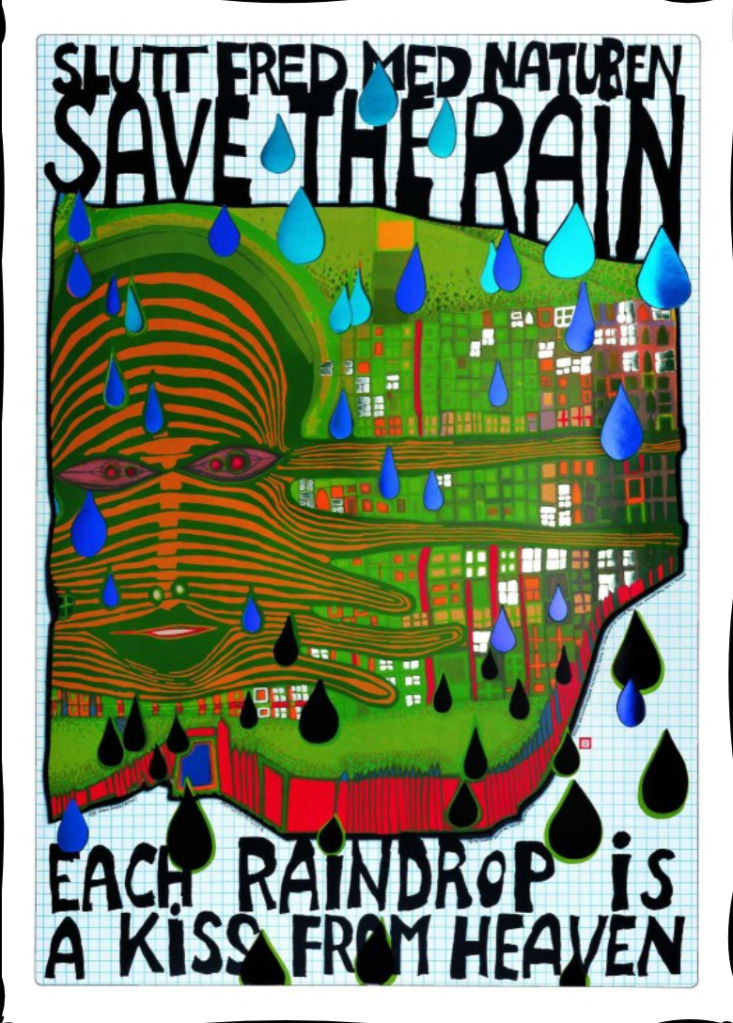
    While visiting the Kunst Haus Wien, I was especially moved by Hundertwasser’s poster “Save the Rain – Each Raindrop is a Kiss From Heaven,” created for the Norwegian Nature Conservancy Association to raise awareness about acid rain and its impact on forests and fish. Seeing this work in person filled me with a deep, expansive gratitude for the miracles of the natural world.

    The phrase “Each Raindrop is a Kiss from Heaven” overwhelmed me with how extraordinary our planet truly is—how every organism, from grasslands to glaciers, plays a critical role in maintaining the balance that allows us to have clean air, water, food, and medicine. These everyday miracles are sacred gifts. Protecting them is not just an act of care; it is a privilege and our responsibility as beings on this earth.

    Manifestos for People and Planet

    Hundertwasser spread his ecological positions in numerous manifestos, letters, and public demonstrations. His “Mouldiness Manifesto Against Rationalism in Architecture” from 1958 introduced ideas that remain profoundly relevant today, including the concept of “tree duty” which views integrating vegetation into architecture as a moral and ecological responsibility, promoting the idea that trees should grow on buildings as living architectural elements.

    The 1958 manifesto generally called for humanity to restore its relationship with nature by returning to organic, evolving, and humanistic architecture. This vision foreshadowed current movements in sustainable design and biophilic architecture, which similarly emphasize harmony between humans, structures, and the environment.

    Tangentially, Hundertwasser campaigned for forestation of the city through rooftop gardens and “tree tenants” that integrate greenery into urban architecture. He also developed and promoted eco-friendly waste management systems, including humus toilets and biological water purification that used aquatic plants to clean wastewater naturally.

    His buildings, such as Vienna’s Hundertwasserhaus and Kunst Haus Wien, are living artworks characterized by vegetation and a jubilant embrace of imperfection.

    In a world of homogenized cities and ecological neglect, his work proclaimed a rebellious return to nature.

    Lessons from Hundertwasser: Honoring Non-Traditional Climate Action

    Hundertwasser’s activism teaches several vital lessons. First, resistance to environmental degradation does not only require scientific credentials—it needs vision, creativity, and the courage to break away from conventional norms.

    Hundertwasser’s “Everybody Must Be Creative” manifesto argues that creativity is a fundamental human right and necessity, not a privilege of artists. He condemned what he called “the new illiteracy”—the inability to create—claiming that modern civilization suppresses innate imagination through education and standardization. 

    Hundertwasser reminds us that solutions to complex problems such as the climate crisis demand imaginative engagement from all fields and backgrounds, making creativity an essential skill across disciplines.

    His philosophy insists that ecological stewardship is a community responsibility, one that flourishes when everyone, from architects to artists and activists to ordinary citizens, claims a role in restoration and advocacy.​

    It is essential to recognize that climate action thrives through diversity of approach. Non-traditional methods like art, music, storytelling, and participatory design can catalyze real change, inspire empathy, and build movements.

    By embracing creative resistance and fostering interdisciplinary collaboration, we can expand our impact—making space for everyone to contribute, innovate, and inspire.

    To honor Hundertwasser’s legacy means advocating for the importance of art alongside science and ensuring that sustainability remains a vibrant, imaginative movement.

  • The Nutrient Deficiency Myth, Debunked: What a Vegan Diet Really Provides

    Have you ever associated going vegan with the fear of missing out on vital nutrients? You’re not alone—this myth has been circulating for years. But science, insights into propaganda used by the meat industry, and my personal journey—tell a very different story.

    Photo by Samuel Girven on Unsplash

    Typical American diets are often heavy in processed meats and low in fiber. In contrast, vegans get significantly more micronutrients like fiber, vitamins C and E, and minerals such as magnesium. These nutrients are vital in supporting heart health, immune function, and overall wellness. Contrary to popular belief, plant-based eaters consistently meet or exceed recommended protein intakes through legumes, tofu, tempeh, nuts, seeds, and whole grains. With variety, all essential amino acids are covered.

    Meanwhile, omnivorous diets can ironically lack many of these key micronutrients, despite providing ample protein and calories.

    Since I began pursuing strength training and body composition goals on a vegan diet—alongside other active hobbies like dancing and hiking—I’ve experienced firsthand how plant-based nutrition fuels athletic performance and aesthetic goals.

    My personal experience reflects what the science shows: a well-planned vegan diet provides all the essential nutrients needed for muscle growth, sustained energy, and recovery.

    What’s the Difference Between Micronutrients and Macronutrients?

    Understanding nutrition is like maintaining a car—you need both fuel and sparts to keep it running.

    Macronutrients are your fuel: carbohydrates, proteins, and fats. Carbs provide quick energy, proteins build and repair tissue, and fats store energy and support vital functions.

    Micronutrients—vitamins and minerals—are like the spark plugs and wiring. You need them in small amounts, but they’re essential for metabolism, immunity, brain function, and bone health. Without them, even the best “fuel” can’t keep the system running smoothly.

    How Vegan Diets Boost Health

    A vegan diet centered around whole foods like fruits, vegetables, grains, legumes, nuts, and seeds is naturally packed with essential micronutrients. These include vitamins C and E, magnesium, potassium, zinc, copper, and antioxidants that help your body run clean and efficiently.

    Collagen Production

    Many of these nutrients support collagen production, which maintains healthy skin, joints, and connective tissue. Vitamin C stabilizes collagen fibers, zinc and copper support its synthesis, and vitamins A and E aid in cell renewal and protect skin structures. This profile not only bolsters heart health and digestion but also helps keep skin strong and youthful.

    Muscle Growth and Function

    Micronutrients play crucial roles in muscle function. Calcium triggers muscle contractions, potassium helps muscles relax and prevents cramps, and magnesium supports energy metabolism.

    Great plant-based sources include:

    • Calcium: fortified plant milks, tofu, kale, bok choy
    • Potassium: bananas, sweet potatoes, spinach, avocados
    • Magnesium: almonds, cashews, pumpkin seeds, whole grains, leafy greens

    Iron and B vitamins (B1, B6, B12, folate) are essential for delivering oxygen and energy to muscles. Iron transports oxygen, while B vitamins convert food into energy. Find these in lentils, chickpeas, quinoa, spinach, pumpkin seeds, whole grains, legumes, nutritional yeast, and dark leafy greens.

    Vitamins C and E and minerals like zinc aid post-exercise recovery and reduce oxidative stress. Sources include citrus fruits, strawberries, bell peppers, broccoli (for C), nuts, seeds, spinach (for E), and beans, lentils, and seeds (for zinc).

    Vitamin D and zinc also support immune health and hormonal balance—key for consistent training and recovery. Vitamin D can be found in fortified plant milks, sun-exposed mushrooms, and supplements as needed.

    In my experience, I’ve had more energy to pursue multiple sports—including weightlifting, dance, and hiking—on a plant-based diet than I did on an omnivorous one. Although I tracked my macronutrients more rigorously on an omnivorous diet, I’ve found it easier to reach my strength, stamina, and aesthetic goals by prioritizing nutrient-dense, plant-based foods. I attribute this to getting adequate macronutrients alongside a significantly higher intake of micronutrients. The boost in vitamins and minerals has also enhanced my focus throughout the day.

    What About B12?

    Contrary to popular belief, meat itself does not naturally contain high levels of B vitamins; rather, it’s produced by microbes and added to animal feed in industrial farming. This means most people consuming meat get B12 that was supplemented earlier in the food chain.

    Fortified foods such as nutritional yeast provide a direct, reliable source for vegans.

    Increased Immunity

    Since going vegan, I rarely get sick and recover quickly when I do. I feel more energized and no longer experience the frequent colds I used to. Whether it’s due to increased vitamin C, zinc, antioxidants, or overall nutrient density, the shift has been profound.

    And the data backs it up: A 2021 study in BMJ Nutrition, Prevention & Health found that people on plant-based diets had a 73% lower risk of moderate-to-severe COVID-19. Researchers attributed this to higher intakes of vitamins, antioxidants, and fiber, which reduce inflammation and boost immune defenses.

    How Meat Industry Propaganda Fuels Nutrient Myths and Greenwashing

    The enduring myth that vegan diets are nutritionally insufficient is not merely a misunderstanding—it is actively propagated and reinforced by coordinated marketing and lobbying campaigns funded by the meat industry.

    This industry exploits a fundamental human instinct: the desire to protect our health and well-being.

    By weaponizing legitimate health concerns, the meat sector promotes the narrative that meat is essential for strength, vitality, and overall wellness.

    Each year, the meat industry deploys powerful advertisements that positions meat as the primary or exclusive source of vital nutrients such as protein and B vitamins. These campaigns use cultural symbols, linking meat consumption with masculinity, patriotism, tradition, and cultural identity.

    Ironically, many nutrients long attributed to meat actually come from supplements administered to animals before slaughter, rather than naturally occurring in the meat itself—as noted above regarding vitamin B12.

    Marketing tactics target young demographics and schools by funding educational materials that vilify plant-based alternatives as unnatural or overly processed.

    Simultaneously, the industry promotes “net zero” sustainability pledges that omit critical emissions sources like deforestation linked to feed crop production, misleading the public regarding meat’s true environmental costs.

    Beyond traditional advertisements, the meat industry has invested tens of millions of dollars into orchestrated misinformation and disinformation campaigns designed to obstruct transitions toward plant-based diets and challenge studies advocating for reduced meat consumption for human and planetary health. This includes providing funding to scholars, research centers, and public relations firms that produce and disseminate messaging aimed at undermining scientific consensus on the environmental and health impacts of meat consumption. For instance, the University of California Davis’s CLEAR Center has received nearly $12.5 million in meat industry funding to challenge studies advocating for reduced meat consumption and to lead campaigns such as #yes2meat.

    In 2023 alone, the U.S. meat industry spent over $10 million on political contributions and lobbying. For example, Tyson Foods spent about $1.67 million on federal lobbying in the 2023-2024 cycle; WH Group spent $1.04 million; JBS, $440,000; and the North American Meat Institute, $186,767.

    This intensified financial clout coincides with rising scrutiny of meat’s environmental and health impacts, as well as a cultural surge in traditional norms linking meat and dairy consumption to masculinity.

    These campaigns create confusion. Many people wrongly believe beef is sustainable through inaccurate sustainability pledges and that plant-based diets are nutritionally lacking. Such misinformation is used to protect industry profits and delay the urgently needed policy reforms to reduce emissions and safeguard public health.

    Recognizing this complex propaganda ecosystem is essential to understanding why nutrient deficiency myths persist and empowers people to make informed, health-conscious, and sustainable choices.

    Vegan Diets Are Better for the Planet—And That Supports Our Health

    Eating plant-based doesn’t just benefit your body—it helps regenerate the systems that sustain all life on Earth. Compared to animal-heavy diets, plant-based eating uses far less land, water, and energy while slashing greenhouse gas emissions.

    Studies from  Oxford and Harvard show that shifting to plant-based diets can reduce environmental impact by up to 75%, while also lowering risks for heart disease, type 2 diabetes, and some cancers.

    This shift reduces environmental pressures and restores ecosystems, which in turn provide cleaner air, purer water, and greater climate stability—directly benefiting human health.

    It’s a powerful feedback loop: eating plants helps protect ecosystems, and thriving ecosystems support human health in return.

    How Plant-Based Diets Restore Natural Systems

    • Water Cycle Support: Switching to plant-based diets could significantly decrease water use on a global scale. When less water is needed for crops, and less pollution enters rivers, this allows aquifers to recharge, rivers to flow, and ecosystems to recover.
    • Carbon Cycle and Climate Regulation: Vegan diets could reduce food-related emissions by up to 86% by retiring grazing land and monoculture feed crops to make space for forests and grasslands to regrow. This helps to improve air quality and restore carbon sinks.
    • Healthy Ecosystems = Healthy Humans: Intact ecosystems filter air and water, regulate temperature, prevent erosion, pollinate crops, and buffer natural disasters. These services reduce disease, support food security, and strengthen community resilience.

    Fuel Your Body and the Planet with Plants

    Vegan diets deliver both the robust fuel (macronutrients) and essential parts (micronutrients) your body needs—while caring for the Earth. They bust the nutrient deficiency myth by offering a rich spectrum of vitamins, minerals, and antioxidants to support muscle performance, collagen production, immunity, and vitality.

    By choosing plants, you’re efficiently fueling your body, fine-tuning your health, and creating a better world for everyone. I’ve felt this transformation in my own energy, immunity, and strength—and science backs it up.

  • The Hidden Currents of Consumption

    As the sun swims through the sign of the Crab, we enter a season ruled by the Moon, the celestial body that commands the oceans’ tides. A primordial longing flows through us. We’re drawn to rivers, lakes, beaches, and streams, urging us to return to the planet’s circulatory system: water, the lifeblood of Earth.

    Cancer calls us to care for what nourishes us. As sunflowers reach for the sky and peaches swell with sweetness, the gifts of summer rely on the same water we seek for solace, are made of ourselves, and depend on to survive.

    But what happens when this essential element is in crisis?

    Photo by Chris Lawton on Unsplash

    Water stress now affects over 4 billion people for at least one month per year. Climate change, poor water governance, and pollution are diminishing both the quantity and quality of our freshwater reserves. In many parts of the world—including the western U.S., India, the Middle East, and regions of sub-Saharan Africa—demand has begun to outpace supply.

    It’s easy to separate the ocean from the stream near your home, or the tap in your kitchen. But they’re part of the same story. Over 80% of ocean pollution originates from land—carried downstream by rivers stripped of their buffers and wetlands polluted by industrial development.

    This is why caring for rivers, lakes, and wetlands is also ocean conservation. It’s why holistic water management—across the entire hydrological and industrial supply chain—is essential.

    The Hidden Water in Our Consumption

    The water supply chain is a vast and intricate system:

    • Water is drawn from rivers, lakes, reservoirs, and aquifers.
    • It’s filtered, treated, and conveyed—often through aging, leaky infrastructure—to homes, farms, and factories.
    • Used water becomes wastewater, which must be captured, cleaned, and either discharged or ideally, reused.

    In US cities across Georgia, Illinois, and Michigan, up to 80% of treated water is lost before it even reaches a faucet due to degrading infrastructure. And a far greater share of water is invisible to us, embedded in the products we consume daily.

    This is known as virtual water, or more precisely, a product’s water footprint. It measures the total volume of water used across a product’s life cycle—from production to disposal. The average water footprint of a pound of beef is around 1,800 gallons. A single cotton T-shirt? Nearly 3,000 gallons.

    To understand these numbers, it helps to break water footprints into three components:

    • Blue water refers to surface and groundwater from lakes, rivers, and aquifers that is used for irrigation, manufacturing, and household needs. It’s the most visibly extracted and often the most contested.
    • Green water is the rainwater stored in soil and used by plants. It supports crops and forests and is essential for agriculture that relies on rainfall rather than irrigation.
    • Grey water, in this context, measures the volume of freshwater needed to assimilate pollutants and restore water quality to safe levels. It’s the hidden cost of contamination—how much clean water must “dilute” the waste we’ve introduced.

    When we consider this fuller picture, it becomes clear: water scarcity is not limited to deserts or drought zones. It is built into global trade, stitched into textiles, and woven into the very infrastructure of modern consumption.

    Within this tapestry, our choices ripple outward.

    Responsible Consumption

    A shift toward veganism is not merely dietary—it’s a profound act of water stewardship. Producing plant-based foods generally requires significantly less blue and green water than animal agriculture, which demands irrigation for feed crops and vast volumes for livestock upkeep. By embracing more plant-forward meals, we ease nature’s burden, allowing water to remain in wild places, nourishing ecosystems and communities alike.

    The same applies to the clothes we wear. Growing crops like cotton requires significant amounts of blue and green water, while dyeing and processing fabrics contributes to grey water pollution on a massive scale. Yet when we choose reused or recycled textiles, we can avoid unnecessary resource extraction.

    Capitalism and the Privatization of Water

    To speak of water scarcity as a matter of personal virtue alone is to mistake the tributary for the river. The burden of sustainable consumption, so often placed on individuals, obscures the deeper currents of exploitation that shape our present crises.

    Under capitalism, rivers are dammed and diverted, aquifers drained, and watersheds sacrificed at the altar of growth. Market logic privileges extraction over renewal, severing water from the web of life it sustains.

    “Capitalism turns material abundance into socially constructed scarcity. No resource—not even water—is exempt from that violent process.” – Meg Hill

    Corporations and states, in their quest for capital and control, privatize and siphon water from the commons which leaves communities deprived and ecosystems depleted.

    In the U.S., nearly 73 million people rely on private water companies, which often charge rates nearly 60% higher than public utilities. While some claim privatization brings efficiency, many of these companies are less accountable to the public and have been criticized for underinvesting in infrastructure while extracting steady profits from a basic human need.

    Meanwhile, financial markets have begun treating water as a speculative asset. In 2020, the CME Group launched a water futures market in California, allowing investors to trade on scarcity itself.

    Michael Burry, the investor known for predicting “The Big Short,” has publicly stated that the best way to invest in water is through food production—growing crops in water-rich areas and selling them in water-poor regions—not by buying water rights directly. The growing involvement of private investors in water rights and infrastructure raises concerns about balancing profit with public access, especially as many communities face water shutoffs, contamination, and drought.

    Corporate Water Consumption

    In many places, water is not a right but a privilege. Its availability is governed not by need, but by wealth, geography, and political power. For example, in Mesa, Arizona, a desert city facing prolonged drought, Meta and Google have built massive data centers that rely on millions of gallons of potable water daily for cooling. These facilities can use as much as 4 million gallons per day, which is enough to supply water to tens of thousands of people. Residents and tribal groups are left scrambling to secure remaining resources, highlighting how access to clean water is granted to those with leverage, not need.

    This is not an anomaly. Across the world—from avocado exporters in water-privatized Chile, where entire rivers are diverted to serve export markets, to Coca-Cola bottling plants in India that have drained local aquifers and left surrounding villages parched—access to water increasingly flows toward corporate greed, not ecological need or human rights. This global economic order, built on the extraction of “cheap nature,” externalizes its costs onto the most vulnerable. Through these examples we can see that the ultra-wealthy are positioning themselves to profit from water while millions face shutoffs, contamination, and drought reveals the brutal logic of commodification: water flows not toward life, but toward capital. Those least responsible for water degradation often suffer its gravest consequences.

    Water as a Weapon of War

    Water injustice also takes political and colonial forms, with one of the most extreme examples occurring in Palestine, where control over water is wielded as a tool of occupation and exclusion. These layers of oppression deepen the global struggle for water justice and remind us that water is inseparable from broader fights for freedom and dignity.

    Water Justice Advocacy

    Yet acknowledging these systems is not to surrender. Our choices—how we nourish ourselves, how we dress, how we show up for what we believe in—still create ripples in the current.

    Water carries us across oceans, through summers, and through survival itself. To honor water is to protect what sustains us. Not just in moments of drought or disaster—but daily, collectively, deliberately.

    This means rejecting the myth of limitless extraction and embracing an ethic of reciprocity. True transformation won’t come from consumer virtue alone. It demands systemic accountability, collective action, and a reimagining of our relationship with water—and with one another.

    We must advocate for public water stewardship, invest in resilient infrastructure, and support movements fighting for environmental and social justice. Because water is not a commodity. It is a life source. A right. And its fate is inseparable from our own.

  • Juneteenth in a Burning World: Prison Labor, Wildfires, and Systemic Racism

    As we reflect on Juneteenth and its legacy of freedom, we must also reckon with the ways systemic racism still permeates our society—especially in how we prepare for and respond to climate disasters. Today, one of the most egregious examples of this injustice is playing out in real time: while the federal government dismantles environmental protections and disaster infrastructure, it increasingly relies on the underpaid, or often unpaid, labor of incarcerated people—disproportionately Black and brown—to fight wildfires. This is not just a policy failure; it is a modern form of environmental slavery.

    Photo by Heather Mount on Unsplash

    Defunding Disaster Response and Climate Policy

    Climate change has intensified the severity and frequency of wildfires across the United States. Over the past 40 years, the average number of acres of forested land consumed by wildfires each year in the United States has increased by 1,000%.

    Rather than addressing this crisis with the urgency it deserves, the Trump administration has actively undermined the nation’s ability to prevent and respond to climate disasters by:

    • Defunding Disaster Infrastructure: Trump has pushed to phase out FEMA, shifting responsibility to under-resourced state governments.
    • Data Destruction: Eliminating NOAA’s “billion-dollar disaster” database erases a critical tool for tracking climate-related damage and allocating aid.
    • Withdrawal from Climate Agreements: Exiting the Paris Agreement and cutting $3.7 billion in clean energy and carbon capture funding—including California decarbonization projects—further isolates the U.S. from global climate efforts and abandons marginalized communities to worsening environmental risks.
    • Unequal Disaster Aid: FEMA’s funding formulas often require local cost-sharing, leaving low-income communities behind. Studies show that as the proportion of people of color increases in a region, the amount of federal disaster aid tends to decrease.

    The Rise of Exploitative Prison Labor

    As federal climate infrastructure erodes, the state turns to prisons—not prevention. In California and beyond, incarcerated people are increasingly relied upon to fill the labor gap in wildfire response. These individuals—often Black or brown—are paid as little as $1 a day, if anything, to perform life-threatening work without proper training, gear, or protections.

    This isn’t rehabilitation or opportunity. It’s exploitation. Incarcerated firefighters are frequently barred from post-release employment in the very field they risked their lives to serve. They are often denied parole, early release, or livable wages. Meanwhile, the state profits from their labor during climate disasters caused in part by the very same policies that left their communities unprotected.

    This system is not new. It is a direct continuation of America’s long history of racialized labor exploitation. The 13th Amendment abolished slavery except as punishment for a crime—and this loophole has been systemically weaponized to maintain racial hierarchies through incarceration. For example, Black Americans—just 13% of the U.S. population—make up 37% of the prison population. Over 80% of arrests are for low-level, nonviolent offenses, and Black youth are disproportionately targeted for surveillance and criminalization.

    The more fires we face, the more bodies are needed. And because of systemic racism in policing and sentencing, those bodies are overwhelmingly Black and brown. This creates a feedback loop: environmental neglect feeds incarceration, and incarceration becomes a substitute for climate policy.

    The Feedback Loop of Neglect

    Black and Indigenous communities, along with other communities of color, are more likely to live in wildfire-prone areas or to suffer the cascading consequences of these disasters—such as poor air quality, housing instability, and economic loss. These vulnerabilities are not accidental.

    The same communities that are over-policed, under resourced, and left behind in public health planning are then called upon to clean up the very disasters they were never protected from in the first place.

    This is not just an environmental issue—it is a racial and human rights crisis.

    Why This Matters for Juneteenth

    Juneteenth commemorates the day when enslaved people in Texas finally learned of their freedom—two and a half years after emancipation was declared. It is a day of resistance, celebration, and reckoning. But it is also a reminder: freedom was delayed, and it remains incomplete.

    In 2025, Black Americans are still being forced into unpaid labor under deadly conditions. Still disproportionately policed and imprisoned. Still left out of disaster response while being asked to carry it on their backs.

    To honor Juneteenth is to demand more than symbolic freedom. It is to fight for a future where Black communities are not over-policed, over-incarcerated, or overexploited—but are protected, resourced, and central to our vision of a world that is prioritizes peace and prosperity for people and the planet.

  • Lusted After, Never Loved: How Patriarchy Undervalues Women and Nature

    Photo by Guzmán Barquín on Unsplash

    In our highly modernized urban landscapes, the 21st-century man often yearns for the wild adventures of imperial explorers from centuries ago. On weekends, they flee the drudgery of their 9-to-5 routines, seeking solace in nature’s grandeur—long-distance running through fields, climbing to the highest peaks, and gliding down snow-capped slopes. These landscapes promise beauty and joy, and an escape from the monotonous reality of daily life.

    Yet, beneath this pursuit of beauty and excitement lies a troubling pattern. The earth becomes a playground for exploitation, a backdrop for thrill and profit, with its habitats rarely cared for and the boundaries of the planet ignored and disrespected. Too often, the well-being of nature is neglected, just as the well-being of women is disregarded and undervalued.

    This is not a relationship of reverence, but one of conquest—where nature is engaged with only through doing, proving, and performing. In this worldview, stillness is weakness, and appreciation without extraction is unthinkable.

    The male voyager who dreams of visiting the earth’s most scenic destinations simultaneously ignores the degraded ecosystems that lie in between. He prefers that the deforested habitats with eroded soil, reduced fertility, and inability to support plant life any longer remain out of view— like a woman who no longer serves his fantasy. Whether it’s the body of a woman or the body of the Earth, what is not useful to him is ignored.

    As men set off on expeditions to indulge in personal growth and discovery by exploring their “motherland,” we women are left to wonder why we have no fatherland. If a woman yearned for the same experience, she would first have to reckon with the threat of violence—from the very men who claim the right to roam without fear.

    Under patriarchy, many men relate to women the same way they relate to nature: they desire only select fragments of the experience, never the whole. Their gaze lingers on isolated parts of the female body, stripped of emotion, thought, or need. Likewise, their relationship with nature fixates on curated landscapes that offer escape and pleasure—spaces that ask nothing in return. In both cases, the full being is ignored, left uncared for, while he takes what he wants and offers no restoration or consideration in return.

    Just as patriarchal systems fragment and objectify women, the dominant scientific paradigm dissects nature into categories and data points, stripping it of spirit, wholeness, and complexity. Male-dominated science systems, especially under colonial and capitalist influence, have long sought to classify, control, and extract rather than to listen, witness, and honor. The desire to “know” nature is often driven not by reverence, but by a need to dominate—just as women are judged and placed into boxes instead of being embraced in the full spectrum of our experience. In both cases, mystery is feared, and complexity is flattened to serve power.

    While it’s important to recognize how Western science has historically been shaped by colonial and patriarchal systems, it’s equally vital to honor the truth in many of its findings—especially when they reveal the urgent need for ecological care.

    Scientists warn that ecosystems may begin collapsing as soon as the 2030s under high-warming scenarios. Yet nearly half of conservative men deny the validity of climate science and the integrity of these projections. Just as the needs of nature are overlooked and seen as exaggerated under patriarchal systems—the stories and rights of women are often dismissed as false and treated with the same disregard.

    I have been confidently reminded by countless men in my life that nature has a way of healing itself as justification for their lack of concern about environmental remediation or protection. But nature can only heal itself from the current level of degradation if there are actions to support the healing process. This may include afforestation and reforestation projects that improve soil health, water cycle regulation, and carbon sequestration.

    This logic, used to excuse inaction, mirrors how society treats women: assuming we will keep nurturing, healing, and caretaking, even as we’re denied support ourselves. Women provide free labor in domestic settings with little support in place to sustain these efforts. The conditioned emotional unavailability of men masked as masculinity leaves women carrying not just the burdens of the home, but the parts of ourselves that men refuse to hold.

    Just as women’s caregiving labor is invisible yet foundational, nature performs essential labor that goes largely unrecognized. Ecosystem services like filtering air, cycling water, regulating the climate, and enabling food production are treated as infinite and free, even though they are the very systems that make human life possible. These life-sustaining processes, much like the domestic and emotional work women perform, are rarely accurately valued, protected, or even acknowledged.

    This pattern of denial and devaluation is no accident— it’s embedded in a larger system that places profit above preservation, and domination above care. Patriarchal capitalism has grossly undervalued nature for much of its existence. Global natural capital has been estimated to be worth $125 trillion yet, nature markets today are valued at only $9.8 trillion.

    As millions of acres of virgin land are opened to oil drilling, creating a product that will only further degrade the land, man’s inability to see intrinsic value without exploitation mirrors how he treats the women in his life. The global economy is built upon a logic that profits from domination and renders care invisible, with billion dollar industries built on the exploitation of the natural world and the exploitation of women—making it fundamentally reliant on undervaluing both.

    Like nature, our beauty is appreciated by man, providing experiences of pleasure and joy. We become the memories that make life worth living. But, we are rarely truly listened to, cared for, or recognized for our full value. We are lusted after, never loved— celebrated for what we offer, but not honored for who we are.

    As a woman, I cherish my beauty. I know its light and magnetism. It has given me connection, expression, and even power. But beauty should not be a reason for exploitation, nor a barrier to being cared for. I want to be held in my wholeness—my strength, my abilities, my sorrow and joy, my stillness and storm. I deserve to be cared for, not conquered.

    Like a goodhearted, patient woman who puts up with the constant chaos of a fiery man, nature is expected to do the same. To tolerate constant growth and expansion that feeds the desire for economic gain and domination harbored by men in patriarchal capitalist systems.

    Our societal structures support relationships devoid of genuine care and connection, enabling further disregard for human and ecological needs on a larger scale. This dysfunction reveals the urgent need for systemic change that confronts the intertwined roots of gender-based oppression and environmental degradation.

    Despite how patriarchal systems have long exploited women’s caring and healing capacities—without recognition or support—these traits remain powerful forces for transformation.

    Compassion, empathy, and emotional depth—qualities often labelled as “feminine”—must be revalued and woven into the foundations of any system that seeks sustainability, justice, and collective healing. These traits are not weaknesses to be exploited, but strengths that offer a path forward—when shared, respected, and integrated across societal structures.

    Throughout history, women have played a critical role in preserving the earth’s health—not just metaphorically, but through direct action. Women in rural and indigenous communities often possess deep knowledge of local ecosystems and have led protective efforts to sustain them.

    For example, in 1973, in the forests of the Indian Himalayas, a group of rural women led by Gaura Devi launched the Chipko Movement, which involved physically hugging trees to prevent them from being demolished. Their act of resistance was not only a defense of the forest, but of their community’s water, soil, and food systems. This was an embodied form of care—one that shows how women’s ecological knowledge and care translates into radical protection.

    This movement, like many others led by women across the globe, reminds us that care is not passive—it is defensive, assertive, and necessary for survival. In contrast to the extractive logic of patriarchal capitalism, these actions reassert a model of relationship based on interdependence and protection, rather than conquest.

    As women under patriarchal capitalism, we must be unwavering in our knowing of our own self worth. We are the creators of life—yet we must still fight to have our contributions recognized, our rights respected, and our full humanity honored. Just as we rise to defend our own dignity, we must rise to defend the ecosystems that sustain all life on Earth.

  • The Illusion of Green Growth: Why Degrowth is a Necessary Path to Sustainability

    Many climate scientists, environmental activists, and researchers, including myself, now reject green growth models, not because of an opposition to progress or innovation, but because the promises of “green growth” in already high-income countries are fundamentally incompatible with the scale of ecological and social challenges present across the globe.

    This preference toward degrowth is rooted in mounting scientific evidence, supported by a recent groundbreaking review published in Lancet Planetary Health titled “Post-growth: the science of wellbeing within planetary boundaries,” which challenges the assumption that economic growth is necessary or even desirable for societal progress.

    Photo by Shelley Johnson on Unsplash

    A central argument made by the authors is that the dominant narrative, which claims technological innovation and efficiency will allow for continued economic growth while reducing environmental harm, is not supported by the data. Efficiency improvements are consistently outpaced by the scale and speed of economic expansion, leading to increased resource consumption, pollution, and waste—a phenomenon known as the “rebound effect.” This effect directly undermines the idea that growth can be decoupled from environmental harm.

    The belief that technological solutions alone can address today’s ecological crises exposes the use of binary thinking to address a multifaceted problem. This technological optimism can distract from the deeper, systemic changes needed to address how societies produce, consume, and define prosperity. Overreliance on technological solutions risks obscuring the fundamental drivers of climate change and social inequality. While technological shifts and innovation will play a role, it cannot substitute for the deeper structural changes needed to address how societies produce, consume, and define prosperity.

    Research shows that market-driven approaches and the current economic system delay effective climate action by hindering the deployment of transformative technologies. Many promising climate innovations struggle to secure funding or scale because profit-driven systems tend to prioritize short-term returns over long-term societal and environmental benefits. Ironically, green growth models also rely on rapid technological deployment as a climate solution, while many proposed solutions are either unproven at scale or insufficient to address the magnitude of the problems.

    Moreover, renewable energy and other sustainable technologies are not without environmental and social costs. The extraction of minerals essential for batteries and electronics, such as cobalt and lithium, is frequently linked to environmental degradation and human rights violations. This is not to suggest that clean energy should be dismissed, but rather that its deployment must be accompanied by systemic reforms. Without broader economic and policy changes, such technologies risk perpetuating existing patterns of overconsumption, social inequalities and human rights violations.

    Crucially, the pursuit of endless economic growth is fundamentally incompatible with the Earth’s ecological boundaries. Humanity has already exceeded six of nine planetary boundaries, threatening the stability of Earth’s life-support systems. The drive for economic expansion, especially in high-income countries, is largely responsible for this overshoot, often achieved at the expense of labor and resources in lower-income nations. High-income countries, in particular, have a disproportionate impact on global emissions and resource use, and their current levels of consumption are unsustainable. If these consumption patterns persist, they are likely to precipitate ecosystem collapse and irreversible climate impacts across the globe. To avert ecological catastrophe and biodiversity loss, high-income countries must significantly reduce their material and energy use.

    Green growth strategies tend to prioritize harm reduction through technological innovation and decarbonization, while neglecting the restorative practices needed to regenerate ecosystems.Even when labeled as “green,” economic growth models frequently fail to deliver meaningful social or ecological outcomes due to the fact that market-driven interventions often neglect ecosystem restoration that is viewed as “non-profitable”. A shift in priorities is needed—from GDP growth to enhancing human well-being, equity, and ecological regeneration.

    True sustainability requires a deliberate reduction in material throughput, regeneration of depleted ecosystems, and advancement of social equity.  It is not enough to simply shift to “greener” forms of production and consumption if they still enable the exploitation and oppression of nature and non-dominant groups.

    As highlighted in recent research published in The Lancet Planetary Health, degrowth offers a scientifically grounded pathway to remain within planetary boundaries while improving health and well-being (Beyer et al., 2024). By intentionally reducing overall consumption and production—particularly in high-income countries—and reorienting economies toward equity, social cohesion, and ecological restoration, we can address the root causes of environmental degradation and social inequality.

    The Lancet article emphasizes that degrowth is not about austerity or deprivation, but about prioritizing human flourishing, reducing unnecessary work and consumption, and ensuring that everyone’s basic needs are met. This approach has the potential to lower pollution, reduce greenhouse gas emissions, and restore ecosystems, while also improving life satisfaction, reducing stress, and strengthening community ties.

    These findings point the way toward a healthier planet, fairer societies, and a higher quality of life for all—achieved not through endless economic expansion, but through a fundamental transformation of our values, priorities, and systems. It’s time to embrace a new vision of progress—one rooted in ecological balance, equity, and genuine well-being.

  • Systemic Risk, Financial Instability, and the Cost of Climate Policy Rollbacks in the U.S.

    As of 2025, the World Economic Forum ranks misinformation and disinformation as the most urgent short-term global threats. While over the next decade, environmental risks dominate, with extreme weather, biodiversity loss, ecosystem collapse, critical shifts in Earth systems, and resource shortages leading the list of long-term risks.

    With disinformation regarding the cost of extreme weather events increasing under the Trump Administration, paired with egregious efforts to reverse the expansion of clean energy and climate action, unaddressed climate risks pose systemic threats to financial stability.

    Photo by Anne Nygård on Unsplash

    Climate Risks as Drivers of Systemic Financial Threats

    Climate related risks can result in microeconomic and macroeconomic threats, this article largely focuses on the macroeconomic impacts.

    Climate risks are divided into two categories: physical risks and transition risks.

    Physical risks: Physical risks can be characterized as acute or chronic, and stem from the direct effects of climate change. Acute physical risks can range from floods, wildfires and storms while chronic physical risks include rising temperatures, sea level rise, and precipitation patterns that can impact crop yields and water scarcity. These events can destroy infrastructure, disrupt supply chains, and lead to large-scale asset losses.

    Transition risks: There are four kinds of transition risks: regulatory, technological, market, and reputational. These arise from the economic, technological and regulatory adjustments required to align with global emissions targets and the shift to a low-carbon economy. Policy changes, technological disruption, and changes in market preferences can lead to stranded assets, sudden changes in asset valuations, and increased legal liabilities for firms exposed to fossil fuels.

    The financial effects of climate risks can be forecasted in various warming scenarios as well as policy and socioeconomic scenarios using scenario analysis. It is best practice to use Representative Concentration Pathways (RCPs) and Shared Socioeconomic Pathways (SSPs) as defined by the Intergovernmental Panel on Climate Change (IPCC) to explore climate impacts in various plausible futures.

    In high warming scenarios, physicals risks present the highest financial risks due to the fact that increased warming will lead to a higher number of costly natural disasters that disrupt supply chains and damage infrastructure. Whereas, in low warming scenarios, transition risks are higher as there will be a more rapid and distinct shift towards renewable energy and more sustainable practices.

    Physical risks differ from transition risks because of tipping points—critical thresholds in natural systems that, once crossed, can trigger irreversible change. While the timing of such tipping points is debated, scientists warn of potentially catastrophic impacts if emissions remain unchecked, with some predicting a point of no return by 2035.

    Both risk types can destabilize the financial system via several channels:

    • Credit risk: Rising defaults as firms and households struggle with climate damages or the declining value of fossil fuel assets.
    • Liquidity risk: Market freezes as uncertainty spikes and asset values become volatile. For example, after hurricanes or floods, households and businesses rapidly withdraw deposits to fund recovery, straining banks’ liquidity buffers.
    • Underwriting risk: Insurance losses mount as more regions become uninsurable, undermining the business model of insurers and their ability to absorb shocks.
    • Market risk: Rapid repricing of assets and increased volatility as investors reassess climate exposures.

    Systemic climate risks are magnified by the interconnectedness of banks, insurers, and investment funds. Losses in one sector can quickly transmit through the financial system, triggering broader instability. For example, insurers retreating from high-risk regions can spark credit crunches, reduce lending, and depress property values, while banks exposed to fossil fuel assets may face sudden losses and liquidity strains.

    These financial risks do not operate in isolation. Instead, they are amplified by political decisions, institutional structures, and the retreat of state-sponsored data collection and oversight.

    Amplification Through Financial and Political Networks

    With the recent announcement that The National Oceanic and Atmospheric Administration (NOAA) has ceased tracking the financial impact of weather events linked to climate change, including floods, wildfires, heat waves and hurricanes, it will become increasingly more difficult to assess current and future costs related to extreme weather events. This change is a result of decisions made by the Trump Administration, supporting their efforts to remove references to climate change from federal documents and resources.

    Financial risks are traditionally incorporated into the financial system as a core element which influences investment decisions, market pricing and the general allocation of capital.

    Currently, climate related risks are in the early developments of being appropriately tracked, measured, and managed within the global financial system as an increasing number of financial regulators recognize that climate change poses significant economic and financial risks.

    For example, the European Union requiring companies to assess, report on, and track management of climate-related risks and their financial effects over a phased in timeline as part of the Corporate Sustainability Reporting Directive (CSRD).

    As climate-related risk measurement, reporting and management is an emerging field itself with financial institutions highlighting that investors are underappreciating and underpricing climate-related risks, this decrease in reliable data is likely to exacerbate the underpricing of climate risks, leading to sudden, disruptive repricing in the future that could threaten financial stability.

    Capitalism’s Structural Conflict with Climate Action as Evidenced by Transition Risks

    Capitalism’s core feature of prioritizing short-term profit maximization directly conflicts with the long-term planning required for climate stability.

    Transition risks emerge precisely because companies are incentivized to resist changes that threaten immediate returns, even when such changes are essential for long-term environmental and financial sustainability.

    This creates what economists call “emergent contradictions,” where short-term economic gains lead to long-term environmental costs. The fossil fuel industry exemplifies this contradiction-remaining economically profitable while significantly driving carbon emissions that threaten planetary stability.

    In a stark display of capitalism’s self-destructive nature, transition risks have fueled organized opposition to climate policy through political channels. For example, industry lobby groups have repeatedly succeeded in blocking regulations or carbon taxes, significantly delaying necessary climate action. This represents not just individual companies protecting their interests but a systemic feature of capitalism where concentrated economic interests can mobilize against policies that serve broader social needs.

    Regulatory transition risks often stem from the introduction of carbon pricing or emissions regulations, which can lead to “a large decline in the value of fossil capital” and the phenomenon of “stranded assets.” These stranded assets reveal one of the clearest ways in which capitalism structurally resists climate action: rather than embracing transformation, industries have powerful financial incentives to delay, weaken, or derail climate policy in order to protect existing investments.

    Although Environmental, Social, and Governance (ESG) frameworks, corporate sustainability, and stakeholder capitalism have emerged to align business with sustainability, their voluntary nature and inconsistent implementation have largely failed to produce systemic change.

    This failure is particularly evident in the U.S., where the political landscape increasingly favors climate denial, fossil fuel expansion, and deregulation. In this context, many corporations are pulling back from ESG reporting, citing reputational risks, regulatory uncertainty, and rising costs, which highlights the limitations of voluntary compliance in a disinformation-driven, privatization-heavy system.

    ESG reporting requires both effort and resources, compounded by the challenge of sourcing reliable climate data, these challenges are only intensifying in a political environment hostile to transparency and science.

    In the corporate sustainability space, investments in climate action typically require a compelling business case that demonstrates either cost savings or a positive return on investment (ROI). These business cases must be socialized and approved internally, often facing resistance due to competing financial priorities.

    However, a core problem remains: financial modeling in capitalist firms typically uses timeframes far shorter than those used in climate models. This misalignment leads companies to prioritize short-term profitability, often opting for inaction—even when the long-term risks of inaction are catastrophic.

    The reality is this: the long-term cost of inaction far exceeds the upfront investment in mitigation or adaptation. Without decisive climate action:

    • The natural resources essential for production will become too scarce or degraded to use.
    • Transportation and distribution networks will be damaged or destroyed by extreme weather.
    • Consumer markets will collapse as people are displaced—or, in some cases, cease to exist.

    Policy Uncertainty and Investment Retraction

    With a patriarchal capitalist leading the country, in the first quarter of 2025 alone, nearly $8 billion in clean energy projects were canceled, closed, or downsized, as manufacturers and investors responded to the rollback of tax credits and regulatory support. This marks a dramatic reversal from the surge in clean energy investment following the Inflation Reduction Act, and signals a broader hesitation to commit capital amid uncertain policy signals.

    Economic Consequences:

    • Stalled clean energy growth: The cancellation of large-scale projects in wind, solar, and battery manufacturing has slowed industry expansion and job creation.
    • Increased exposure to fossil fuel risks: Delayed transition raises the risk that banks and insurers will be left holding stranded fossil fuel assets, amplifying credit and market risks.
    • Reduced resilience to physical climate impacts: Without robust investment in mitigation and adaptation, uninsured losses from extreme weather events are expected to rise, straining public finances and deepening economic inequality.
    • Systemic instability: Allianz and other major insurers warn that, as climate risks become uninsurable, the financial system faces the prospect of cascading failures in housing, credit, and investment markets-potentially threatening the foundations of capitalism itself.

    The Self-Defeating Nature of Capitalism

    Ironically, capitalism’s resistance to climate action threatens the system itself. As financial experts warn, continued failure to address climate change means “no more mortgages, no new real estate development, no long-term investment, no financial stability. The financial sector as we know it ceases to function. And with it, capitalism as we know it ceases to be viable.”

    This demonstrates how transition risks represent not just evidence of capitalism’s resistance to climate action but also its potential self-destruction through that very resistance.

    The intersection of environmental collapse, financial instability, and political resistance reveals a system on the brink. Without structural reform, both ecological and economic breakdowns are not only likely—they are mutually reinforcing.